
-
- Edie Xu: Corte-Tial Inversion
- 2026-10-17
In the group exhibition Supernova, currently on view at MOCUBE, Edie Xu presents works: Capsules and Corte-tial inversion.
Edie Xu currently lives and works in New York and Beijing. She graduated from the School of the Art Institute of Chicago with a Bachelor of Fine Arts degree. She is an interdisciplinary artist whose practice spans sculpture, installation, and performance art. Her figurative sculptures explore the phenomenological relationship between individual existence and space and time, as well as the connections between geophilosophy and material culture.
▌Introduction of Works
Edie Xu
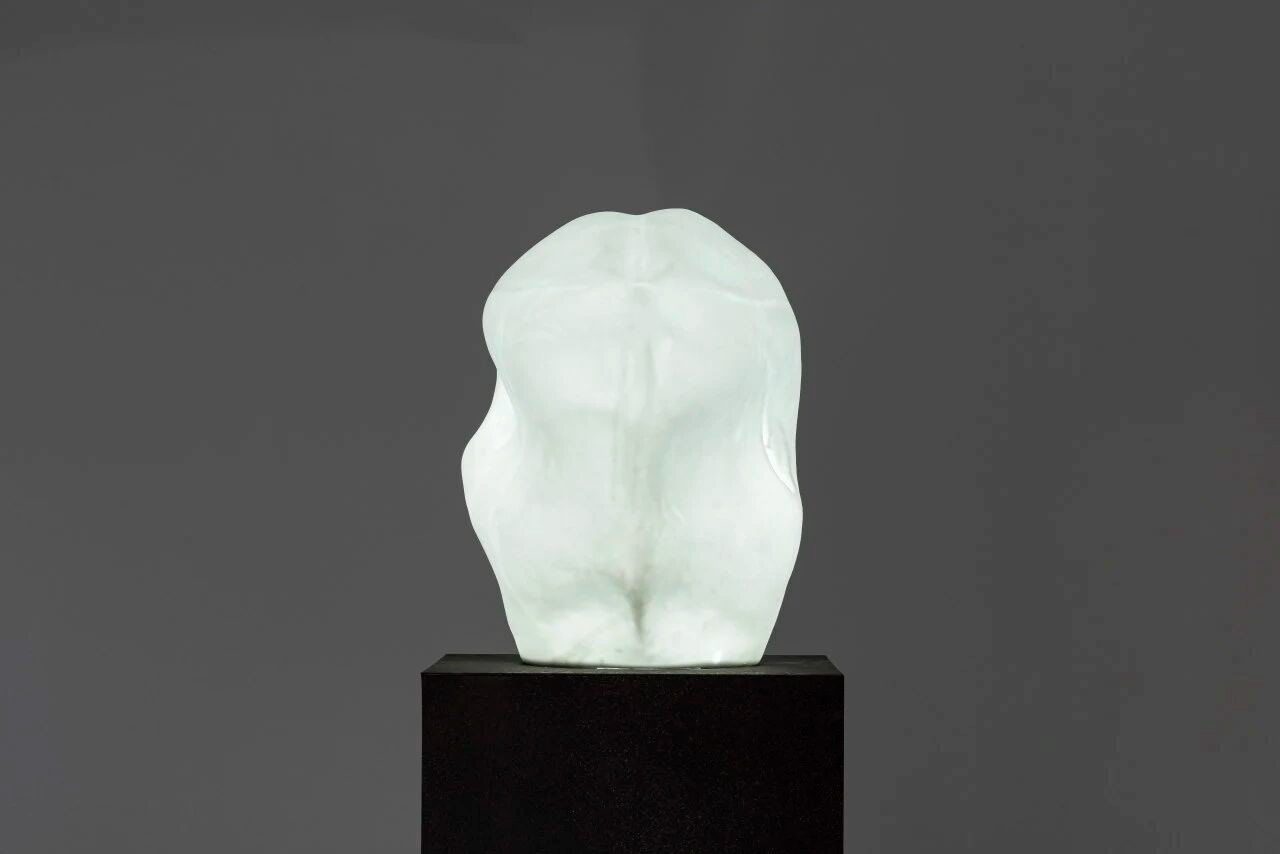
Corte-tial inversion,2025
Slip cast porcelain, metal pedestal, irregular light flicker
~180x36x36cm
This work flickers incessantly, like an LED lamp with a loose connection—on the verge of going out, yet still connected to the current. Its faint sound makes the space feel intimate, audible only in the silence of a closed room, an office, or an elevator. The sound shifts attention from public perception to the listening individual. The form of the work is drawn from the photographic series "LEIGH BOWERY, NEW YORK, 1993" by photographer Annie Leibovitz. That series captures the body resisting gravity in unusual postures: flesh folding, stretching, bearing its own weight. The sculpture rests between body and object, like flesh, yet never coalescing into a human form. Within this ambiguity emerges a sense of bodily autonomy: a form searching for its own posture, its own way of preserving itself.
Edie Xu
Capsules (1-6), 2025
Ceramic and glass, sagger clay, and scent
~25x15x10cm*6
Capsule originates from a friend’s memories of growing up in Beijing’s 798 (797) area in the 1970s, when it was not yet an art district. She recalls the smells she encountered while wandering through the Tiananmen Audio Equipment Factory, where her mother worked and lived: latex, electric welding, metal, and the coarse, steamy smells of Beijing’s winter radiators and public bathhouses. Here, memories gradually fade and evolve, expressing both the limitations of language and the preciousness of individual perception and lived experience.
Mocube held an extended conversation with artist Edie Xu in conjunction with this exhibition. In the following interview, “Mocube” is abbreviated as “M,” and “Edie Xu” as “X.”
M: Your work sometimes originates in very specific personal memories, yet the feelings it ultimately evokes do not necessarily belong to any particular individual. How do you understand the process through which personal experience becomes collective experience?
X: Smell is the most direct of our senses. Olfactory signals bypass the thalamus and travel directly to the amygdala and hippocampus, the brain regions responsible for emotion and memory. Yet the moment a memory is put into words, it begins to fade and transform. The harder we try to articulate it clearly, the further we move away from the original smell, much like how the brain unconsciously rewrites a memory each time we recall it. Everyone’s sensory experience is unique, which also reveals the limitations of language. An artwork can be experienced collectively, but the experience itself remains personal.
M: While studying ceramics and glass in Jingdezhen and engaging with traditional crafts from different regions, you encounter modes of making that differ from your established working methods. When a craft has its own traditions and rules, how do you decide which aspects can be incorporated into your own practice?
X: I hope to preserve the original state of a craft or material in my work, allowing people to encounter techniques that may be on the verge of disappearing. I first seek to understand their relationship to local culture and the land, documenting the process of making before gradually exploring whether new forms of presentation or approaches to creation are possible. Which elements can be incorporated into my work often reveals itself naturally through learning and hands-on experimentation.
M: From the smells of old factories to the traces left by craftsmanship, you seem consistently drawn to things that have disappeared yet continue to leave something behind. How do you understand the relationship between this notion of “residue” and time?
X: “Residue” is like a point of contact between the past and the present. The indentations left by hands pressing into clay and the deformations that occur during firing all bear traces of the making process. Even after an artwork is completed, metal continues to oxidize, kombucha cultures continue to grow, and smells gradually change. Residue, then, is the lingering aftereffect of the past, still unfolding slowly in the present. Time here is not a straight line so much as a process of gradual decay. The act of making may be finished, but the material continues to change. Some forms of residue, meanwhile, may exist only in the realm of memory and imagination—for instance, smell.
-
- Wan Duoyun: The Frozen Tide
- 2026-10-07
In the group exhibition Supernova, currently on view at MOCUBE, Wan Duoyun presents works: Paeans and Unnamed Sea Area.
Wan Duoyun was born in Beijing in 1992. She received her bachelor's degree from the Sculpture Department of the Central Academy of Fine Arts and currently lives and works in Beijing. She primarily works with installation and sculpture, turning her attention to those seemingly intangible and ever-shifting existences—emotion, memory, and identity, those complex yet genuine textures of life. By resetting the contexts and symbolic attributes of everyday objects, she creates a field of "suspension."
▌Introduction of Works
"Paeans" takes "since 1940" as its entry point, borrowing the title of the art history book "Art Since 1940". Art history books of this kind organize complex artistic practices into a readable and teachable history by selecting artists and works, dividing art movements, and establishing historical relationships between works. Works that enter this narrative thereby gain a position of being continuously viewed, discussed, and cited.
Viewers press a button on the installation and hear a generated voice through headphones, narrating a work of art that never existed. The voice, in a nearly incontrovertible tone, endows it with an author, a date, a creative context, and an art-historical evaluation. Because artificial intelligence has learned the language and narrative conventions habitually used in art history, these descriptions of fictional works sound real, complete, and even difficult to doubt. Each interaction generates a new "art history."
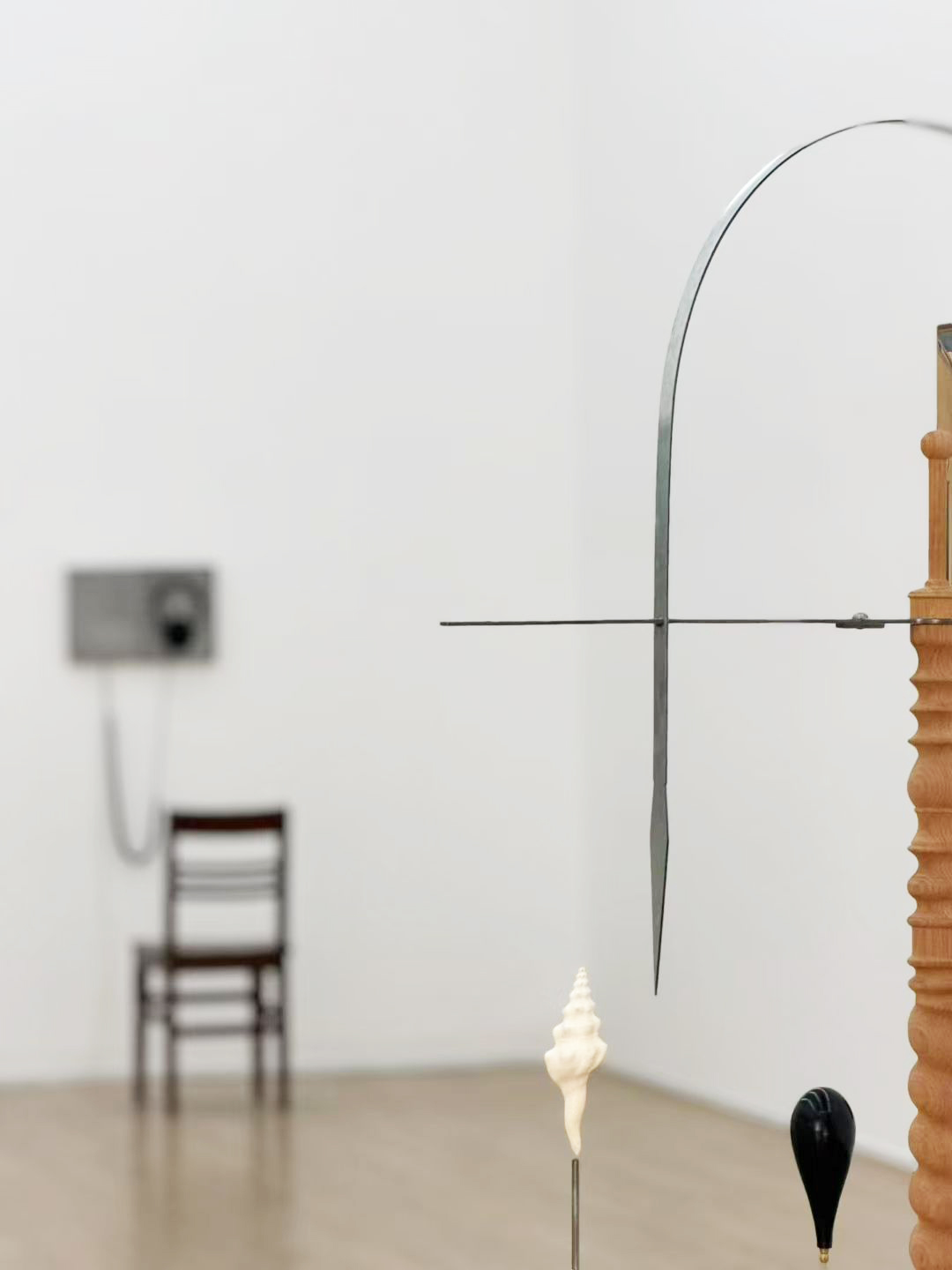
In "Paeans," language becomes a medium for constructing artistic identity and history, and the viewer's press triggers this process. An object that never existed thus acquires a complete historical position, and we are once again confronted with a question: when a work can be narrated with such certainty, where exactly does its "truth" come from?The installation "Unnamed Sea Area" appears with an unusual vertical silhouette. It resembles a stranded lighthouse, or a frozen tide. Embedded at its center is an intimate space: the coarseness of cement, the warmth of wood, the cold hardness of iron and stainless steel, and a conch placed within. When a sea is set into an industrially textured framework, viewing also gains layers, forming an image of "suspension."
Mocube conducted an extended exchange with the artist Wan Duoyun about this exhibition. In the following interview, "Mocube" is abbreviated as "M," and "Wan Duoyun" as "W."
M: "Paeans" borrows the narrative mode of art history to endow never-existent artworks with descriptions and evaluations. Does this simulation of art-historical writing also involve your reflections on how art history constructs artistic value and establishes classics?
W: In art history, an artist is more like a material. Selected, combined, named. It is another work, one that has nothing to do with the artist. In this work, the language system of art history also becomes a kind of material.
M: In "Unnamed Sea Area," the cold, hard cement base and metal lines form a sharp contrast with the warm carved wooden pillars and the naturally formed conch. When choosing materials, how do you balance the conflict and complementarity between this industrial rationality and natural, handmade traces?
W: Intuition makes judgments before rational balance does. Materials themselves carry their own "origins." The cement base seems to have no connection to the ocean, but in my memory it belongs to the ocean—I have seen enormous wave-dissipating blocks beside embankments, submerged by seawater. Materials themselves are chaotic, mixed with their own properties, time, my memories, and emotions. I did not try to balance the industrial and the natural; this is merely a "by-product" of their juxtaposition.
M: From describing nonexistent masterpieces to pointing toward an unnameable sea, your works seem always to be in dialogue with "nonexistence" or "the invisible." From what kind of observation of reality does this fascination with the hidden arise?
W: I have always felt that what moves people is often what is not clear, what cannot be precisely described. Those blurred states that cannot be articulated are closer to truth. Clarity itself also implies a kind of simplification. Intuition and emotion occur where language and matter fail, acting before reason does. Just like poetry.
-
- Shi Ziyuan: The Bell
- 2026-10-04
In the group exhibition Supernova, currently on view at MOCUBE, Shi Ziyuan presents The Bell.
Shi Ziyuan was born in Nanning, Guangxi, and graduated from the Sculpture Department of the Central Academy of Fine Arts. She currently lives and works in Beijing. In her practice, she often employs various media such as kinetic sculpture and sound installation, drawing clues from multisensory experiences including vision, hearing, and bodily sensation, and establishing her own perceptual language through the interplay of sound and space. Mechanical structures, sound elements, and everyday objects interact in her works, while lived experience frequently intertwines with memory and imagination. Her practice also extends to public art and artist residencies, where she continues to explore the relationships among sound, material, and space across different contexts.
▌Introduction of Work
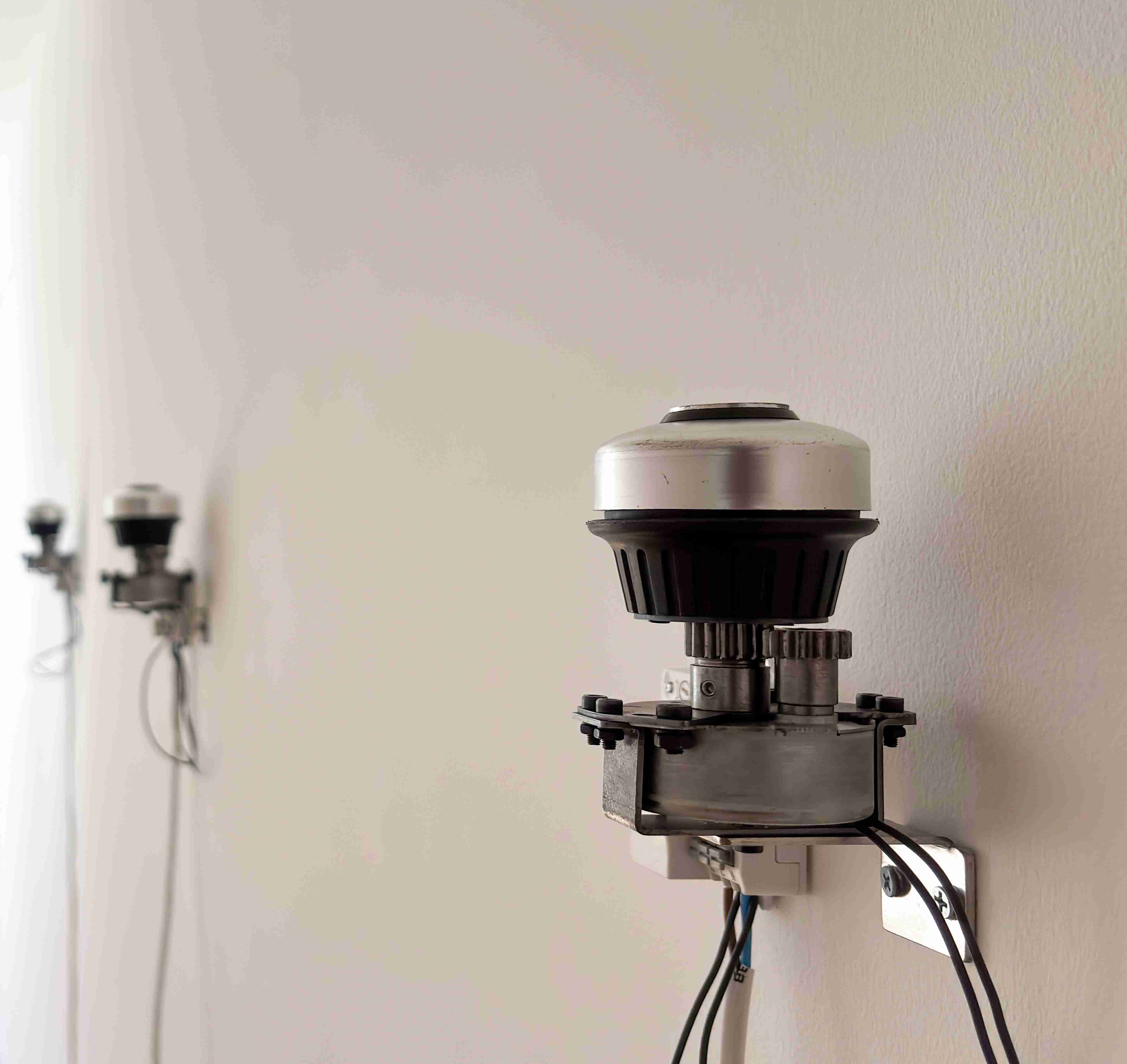
The sound installation The Bell revolves around auditory illusion and spatial behavior. Multiple mechanical devices based on bicycle bells are installed along a corridor space. The bells are triggered as viewers pass by, evoking the judgment that "a bicycle is approaching" and potentially prompting bodily reactions from pedestrians. Originating from the shared bicycle system, the bell sound was originally a standardized urban signaling language; once removed from its original context, it still retains its power to intervene. This exhibition presents three of these devices. In the corridor—an everyday passageway—the bells ring as viewers pass by, briefly intervening in the rhythm of movement through the space.
Mocube conducted an extended conversation with artist Shi Ziyuan regarding this exhibition. In the following interview, "Mocube" is abbreviated as "M," and "Shi Ziyuan" as "S."
M: The work’s most immediate effect seems to be prompting the body to instinctively move aside, pause, or change direction. How do you anticipate or imagine viewers’ bodily responses when creating the work? Do you consider these responses part of the work itself?
S: The Bell, presented in this exhibition, continues my exploration of audiovisual experience, modes of perception, and the sounds produced by materials. It also grew out of an experience while walking down a street: when a bicycle bell rang behind me, I assumed a bicycle was approaching before I could see the source of the sound. Drawing on prior auditory experience, the sound took on a concrete form in my imagination and prompted a bodily response. In creating the work, I anticipate that viewers might move aside, pause, or look back upon hearing the bell. These responses relate to bodily habits formed through urban life. A bicycle bell carries a clear signaling function, and the body often reacts instinctively before visual confirmation. By bringing this familiar sound into the museum, the work reawakens everyday experience in a different setting, making viewers’ bodily responses part of the work. Although responses vary, the fleeting disorientation suggested by “恍” (huang) in the Chinese title emerges in the process of hearing the sound, making a judgment, identifying its source, and reconsidering one’s own response. The sound is real, yet the situation it evokes is momentarily out of alignment with the reality before us.
M: You chose transitional spaces such as ramps, corridors, and handrails rather than a conventional exhibition gallery. Do these spaces already possess a certain “sonic quality” for you, or do they determine how viewers hear the work?
S: In its original installation, the work extended along two ramped corridors in the museum, approximately eighty meters in total length. Multiple devices were mounted on the corridors’ existing metal handrails and triggered to sound as viewers passed. Only three devices are presented in this exhibition, but the corridor still provides the conditions for the work to engage with bodies in motion. The “sonic quality” of these transitional spaces is closely connected to how they organize everyday movement. Corridors and ramps guide people’s passage, while handrails relate directly to bodily position and direction of travel. Footsteps, surrounding activity, and judgments about people approaching from ahead or behind also contribute to our perception of a passageway. When a bicycle bell sounds in such a space, it can readily be understood as a signal relating to passage and movement, influencing viewers’ actions. For me, the space, the bell sounds, and viewers’ participation together constitute the work. The bells briefly intervene in how the passageway is used, drawing attention to how auditory experience continually influences and shapes our everyday actions and spatial judgments.
-
- Aura Sun: Enchantment
- 2026-10-02
In the group exhibition Supernova, currently on view at MOCUBE, Aura Sun presents two works: HEAR ME OUT and Shadow Hunter.
Aura Sun was born in 2001 in Rizhao, Shandong. She received her bachelor's degree in Home Product Design from the Central Academy of Fine Arts in 2023 and her master's degree in Sculpture from the Royal College of Art in the UK in 2025. Her practice spans sculpture, installation, painting, and performance media. She has long drawn imagery from mystical philosophy, alchemy, and Jungian analytical psychology, centering on the enchantment of inner images as she explores the unity of body, mind, spirit, and the world. Religious symbols, dream experiences, and material forms continually overlap in her works, while individual trauma and social repression often interpenetrate with spiritual potential and poetic resonance. In recent years, her practice has gradually taken sculpture and installation as its primary media, while continuing the free and open working methods of her painting and performance practice.
▌Introduction of Works
The Bell in the Cage
The Silent Bell
Let silence strike you and
you will know what sound you can make
In the work HEAR ME OUT, a claw anchor hangs down from the collar of a garment to the ground, and a bright red fishing rope, like an umbilical cord, tightly connects the garment to the claw anchor. The collar, cuffs, and buttons are repeatedly stitched with silk thread. Iron bars arch upward from below, enclosing the garment on all sides like a cage. The garment still retains the contour of a body, yet the specific "person" has already receded. The claw anchor rests quietly beneath the garment, using its own weight to anchor the thoughts and feelings that might drift away at any moment.
Every time a letter opener is used,
a silence disappears from the world.
This is my arsenal: I capture glimmers of inspiration,
and I also raise my banner to annihilate shadows.
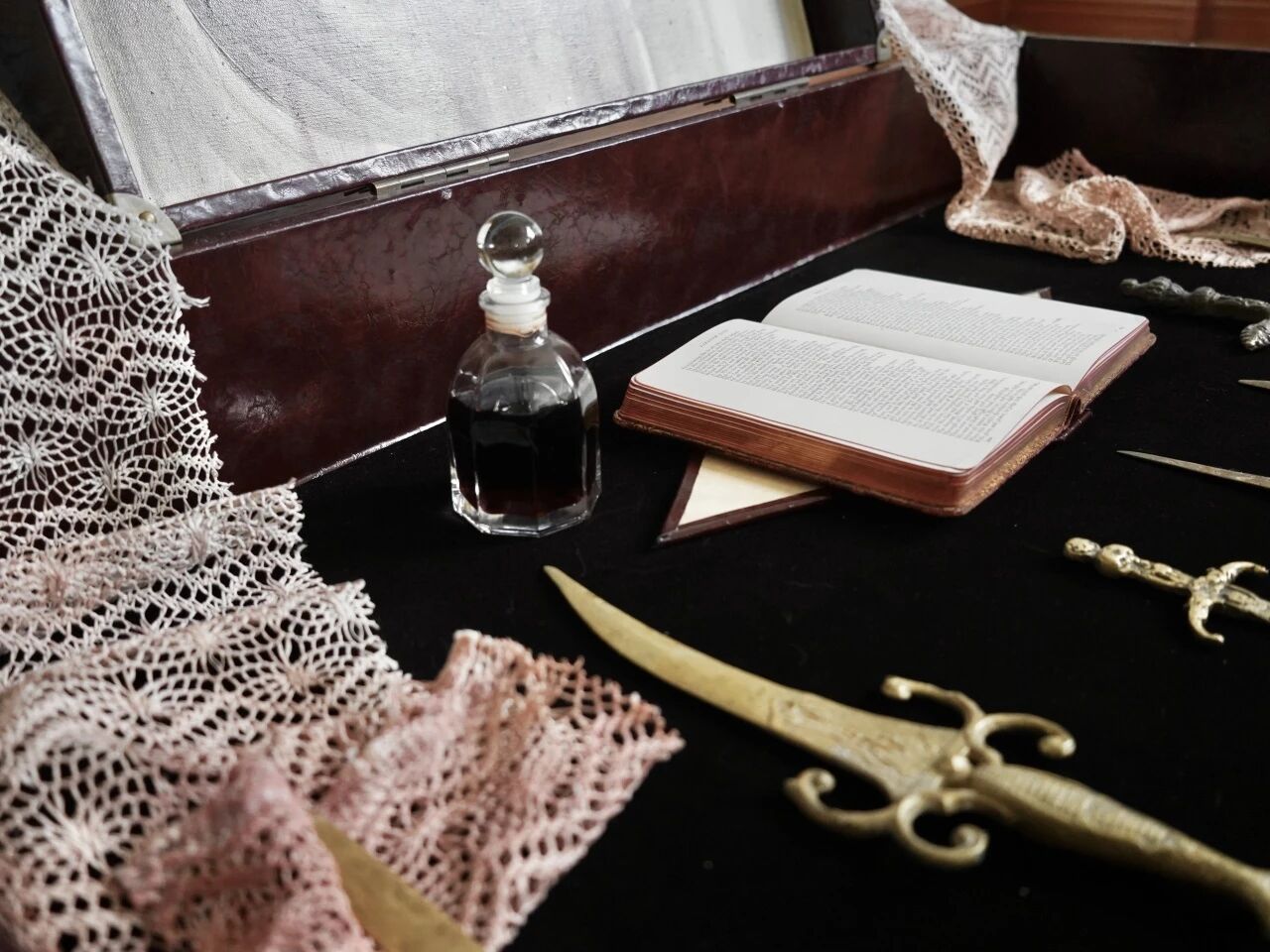
In the installation Shadow Hunter, brass letter openers of various forms are placed inside a wooden box. To pierce is sometimes also to open: the tip of the blade pierces the envelope, moves along the fold, opens a secret, or makes a silence disappear from the world. The letter opener is a special kind of weapon, one whose sharpness does not aim to harm: it enters along the existing creases of the envelope and cuts open the seal in order to protect the letter as completely as possible. The book at the center of the wooden box has already been opened, a glass bottle holding a dark red liquid sits quietly beside it, and curtains hang down from both sides. The entire installation repeats the action of "opening"—it opens up the subconscious's capture of some intangible feeling across the dimensions of space and time.
Mocube and the artist Aura Sun engaged in an extended conversation about this exhibition. In the following interview, "Mocube" is abbreviated as "M," and "Aura Sun" as "S."
M: In your works, the juxtaposed objects all seem to become materials that can be summoned and reassembled. When these heterogeneous things meet, do you see yourself as discovering some originally hidden connection, or, through their combination, making a relationship that does not yet exist become manifest?
S: I think it's both. I believe that "not yet existing" is actually "not yet developed," and that the hidden connections between things already existed long before they became visible. What I do is more about capturing the spiritual essence behind each individual object, and while tentatively touching those hidden connections, composing new discourses through my own sensations.
M: Besides anchoring your attention on the physical properties or origins of the works, you've also mentioned feeling the works through intuition. From creation to everyday viewing experience, what is intuition for you?
S: I think intuition in perceiving the properties of objects is more a kind of experience of texture. "Texture" is something I'm very obsessed with; it is the image on the surface of sculpture, the sculpture on the surface of the image, the "real" in its smallest volume. When I see an object with a texture that evokes a certain feeling, a kind of non-divergent imagination draws the images in my mind to a quiet place, where there is something heavier behind that texture. I think this "non-divergent imagination" pulls intuition along, and intuition is a meeting drawn forth by this pull.
M: You once studied violin, and in your previous period of near-seclusion in creation, you seemed to begin listening to a kind of "musical sound" beyond music itself—the friction of bow and string, the vibration of the body, the rhythms of all things, and those sounds not yet formed into melody, not yet speakable. For you, what is the relationship between "hearing" and "silence"?
S: They have always coexisted; sometimes this relationship is healthy, and sometimes it is very tormenting. "Hearing" and "silence" are somewhat like "remembering" and "forgetting," different from "happening" and "not happening." When I hear, I seem able to remember who I am, and in silence, I possess the capacity to receive everything. In the middle of the relationship between these two there is a "person," an organic soul of great complexity and intricate rhythm, and the relationship between the two also depends on how the soul places itself. When the soul draws closer to "hearing," it draws closer to itself; when the soul draws closer to "silence," it merges more into all things.
-
- Landi: All Things Borrow One Another's Forms
- 2026-09-30
In the group exhibition Supernova, currently on view at MOCUBE, Landi presents three works: Bathing in the Sea, Gauguin’s Fruit, and Vase.
Landi was born in Shenzhen in 1991, with ancestral roots in Shanwei. She graduated from Guangzhou Academy of Fine Arts in 2015 and currently lives and works in Shanghai. Over the long term, she has extracted images from everyday experience and immediate sensations, establishing her own visual language through intense colors and sketch-like lines. Animals, plants, and figures continually undergo morphological infiltration in her paintings, and real experience often overlaps with memory and imagination. In recent years, her practice has gradually taken acrylic on canvas as its primary medium, while continuing the free and open working method of her earlier sketches and mixed-media experiments.
▌Introduction of Works
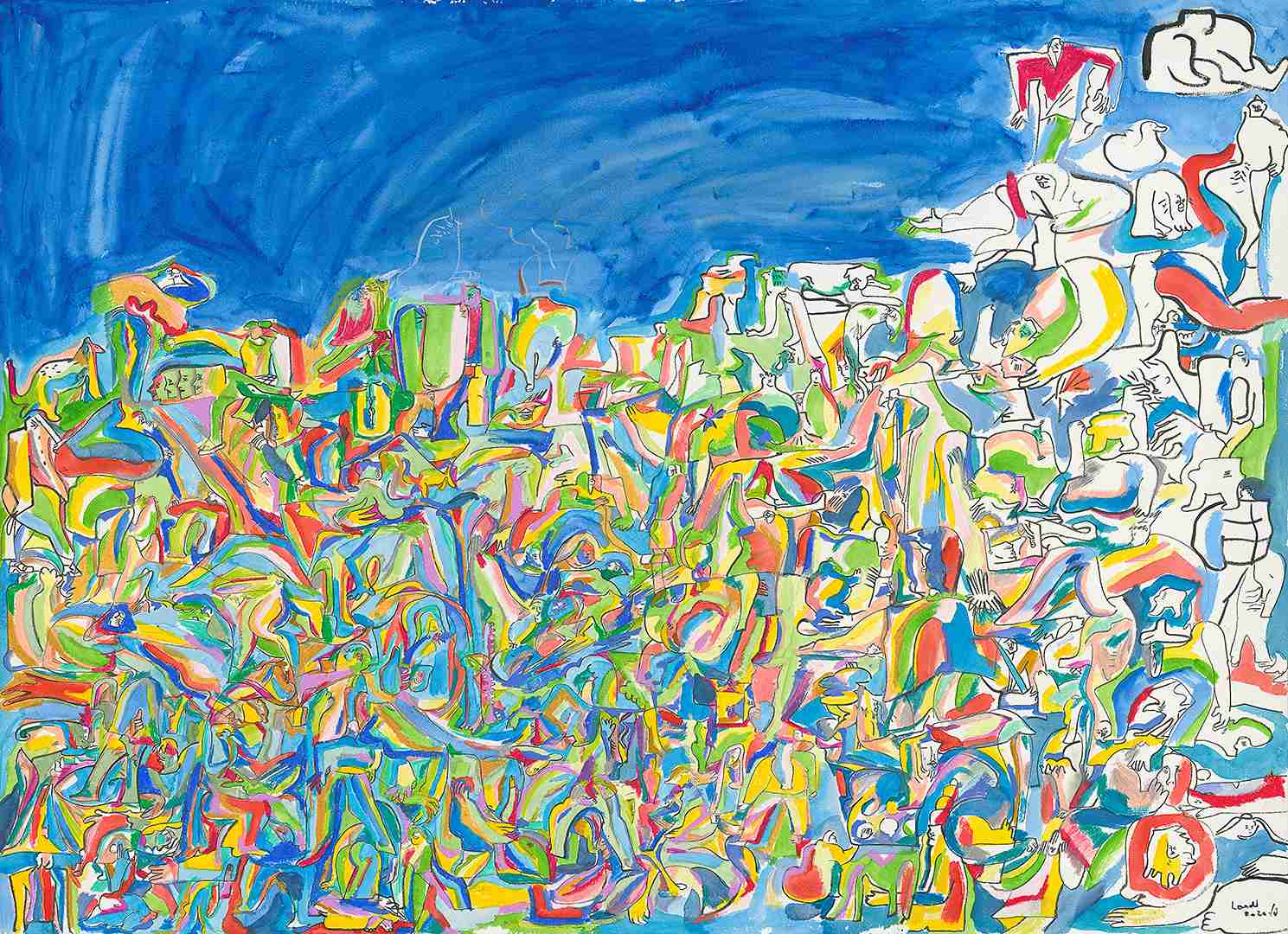
Bathing in the Sea belongs to Landi's earlier "Lao Re" series (a Hokkien dialect term meaning lively, bustling, and clamorous), which comes from her memories of life in the south. "Lao Re" is a dialect expression used in the Hokkien and Chaoshan regions, referring to the lively atmosphere of crowds gathering. It mostly happens spontaneously and randomly: regardless of whether it is a joyous or mournful occasion, neighbors—even those who do not know one another—can naturally gather together to eat, drink, and chat. People appear suddenly like extras on a stage and then quietly disperse, carrying an unordered yet vivid sense of earthy vitality. It was only after Landi
came to Shanghai that the invisible boundaries between people made her realize anew that kind of "liveliness" she had once wanted to escape. In this work, the setting where "Lao Re" takes place has shifted to the sea. For Landi, who grew up in the south, the sea is like a natural public bathhouse, with people entering the water like "dumplings dropped into a pot." In the lower part of the image, densely packed human figures press against one another, lines and color blocks interpenetrating, and the boundaries of the figures are almost swallowed by the surrounding forms; on the right side, some clearly defined body contours remain, as if they are just entering this chaotic gathering. Through the clamor of color, Landi tries to conceal within it her complex feelings about intimacy.
This work continues the creative logic of her "Zoo" series, in which "all things borrow one another's forms." The bright, saturated cobalt blue background flattens the pictorial space, within which human figures, birds, flowers, food, and objects crowd and overlap: the wings of birds and the folds of human clothing, the edges of flowers and leaves, interpenetrate one another; the figures beside the dining table and the contours of plants nest within each other; and the enormous flower petals even merge with the texture of the human body. The starting point of Gauguin's Fruit came from an accidental painting game. A friend drew a table, a wine bottle, and an apple in a sketchbook and wrote, "Seeking Gauguin's fruit." This sudden coded phrase was kept in Landi's heart and gradually came to overlap with her own life circumstances when she first arrived in Shanghai—as if she were tightly clutching that note reading "Seeking Gauguin's fruit," following this faint guidance and moving forward all the way. It relates to the artist's reflection on the original intention of creation: some people pursue success and fame in an external sense, while others care more about whether a work can be seen and whether it can reach a resonance of the soul. We have all, to greater or lesser degrees, had our imaginations confined by the framework of desire, and Landi attempts, through art, to ask herself what exactly the "fruit" she is seeking really is.
The Vase series uses an intense, pure red as its ground, with white contour lines outlining the boundaries of the vase. Inside the vase, tulips, leaves, human figures, and limbs entangle with one another, making it impossible to tell whether the flowers are growing on human bodies or people are hidden among the flowers. Originally stable identity boundaries continuously loosen and deform within the image. A friend once described dating in Shanghai as a "tasting fair": people are like vases, while those around them are like constantly changing fresh flowers. Novelty is easy to obtain, but truly sustained companionship is more difficult. Thus Landi began to reflect on the gap between novelty and lastingness in intimate relationships; by the time she repainted the work in 2024, she poured all her observations of the changes around her into the vase. As she says, "People can also live in a cage of desire, just like animals." We are trapped in expectations for intimate relationships and in the pursuit of novelty, yet while we are in the midst of it, we remain completely unaware. The vase with clearly defined contours in the painting—is it not another form of "cage"? Whether in art or in life, how should we both bloom outward and preserve our own inner shape?
Mocube held an extended conversation with the artist Lin Jiechu regarding this exhibition. In the following interview, "Mocube" is abbreviated as "M," and "Landi" as "L."
M: The three works in this exhibition belong to two series from different periods: Bathing in the Sea from 2020 belongs to the "Lao Re" series, while Gauguin's Fruit and Vase from 2024 belong to the "Zoo" series. Could you first talk about the chronological relationship and inner connection between these two series within your creative trajectory?
L: "Lao Re" began in 2014 with sketches of gatherings in my hometown, and it also carries the questions I have had since childhood about belonging. Later, "Zoo" lets humans, animals, plants, and everyday objects morph into one another, continuing the interweaving of reality and imagination. They are like different amusement rides in "Landi Land"—I switch back and forth between them, keeping each other fresh and gaining the momentum to continue creating.
M: Daily life brings you a great deal of inspiration. You even sketch the people you see around you on the subway. Your works seem like diaries that carry both dreams and reality at the same time. How do you understand the relationship between art and life?
L: For me, painting is like breathing. I observe strangers on the subway, and those expressions enter my dreams as well. Once I dreamed that a person made his own profile into a book, able to flip at any time to the most beautiful angle, and later it appeared in the draft of Gauguin's Fruit. Moments in life continue to grow in this way within the imagination.
-
- Jiang Dantong: Self-Healing Wounds
- 2026-09-29
In the group exhibition Supernova, currently on view at MOCUBE, Jiang Dantong presents three works: Fading Light, Self-Healing Wounds, and Life Is Elsewhere.
Jiang Dantong was born in Shangrao, Jiangxi, in 2000. She graduated from the Oil Painting Department of China Academy of Art in 2026 and currently lives and works in Hangzhou. Jiang Dantong's paintings mainly revolve around individual experience and emotional states. Approaching issues of individual existence from a female perspective, she captures everyday moments and explores inward themes such as bodily memory, spiritual alienation, and self-healing, while also integrating an identification with the vitality of nature into her creations. Her work combines the foundation of classical painting with the spiritual reflections of the contemporary individual. Tempera is the primary painting medium and technique Jiang Dantong uses. She fully utilizes the technical characteristics of thin glazing and multiple layers of overpainting, giving the picture soft, low-saturation color layers while retaining faint traces of the underlying colors and brushwork. This not only creates a warm and gentle texture but also forms an overall restrained and calm rhythm of language.
▌Introduction of Works
In Fading Light, glass cups of different forms occupy almost the entire composition, with light repeatedly refracting across their transparent surfaces. At the center, a single red tulip lies across the tabletop, inevitably stirring the imagination. Through her handling of color layers, Jiang Dantong keeps the edges of the glass slightly blurred, while the white highlights scattered across the walls of the cups continually interrupt the calmness of the image. "Flickering" is both an instantaneous state of light and shadow and a metaphor for everyday moods. Through her depiction from a female perspective, Jiang Dantong endows the glass vessels with emotional warmth: those shimmering yet fading spots of light resemble the fleeting, fragmented feelings of daily life and the shifting passages of memory.
In Self-Healing Wounds, the artist further compresses the viewing distance, selecting a partial view of a knee as the main subject of the image. We can clearly identify the wound on the knee, yet the figure's identity and actions are deliberately weakened. At the same time, the properties of the material are fully highlighted here: after multiple layers of covering, the colors still faintly reveal traces of the underlying layers, and the surface of the painting retains fine brushstrokes and abrasions, shaping the delicate texture of skin. The "self-healing" indicated by the title is essentially a process that unfolds over time. After being damaged, the body initiates self-repair—the wound scabs over, the color fades, and new skin slowly covers the once-broken area—but this does not mean that nothing ever happened. This work is Jiang Dantong's personalized expression of traumatic experience: on the one hand, it concerns the vulnerability of the body; on the other, it reveals the resilience of life. Jiang Dantong avoids a blunt outpouring of pain and instead uses a calm painterly language to quietly narrate a process of human self-healing.
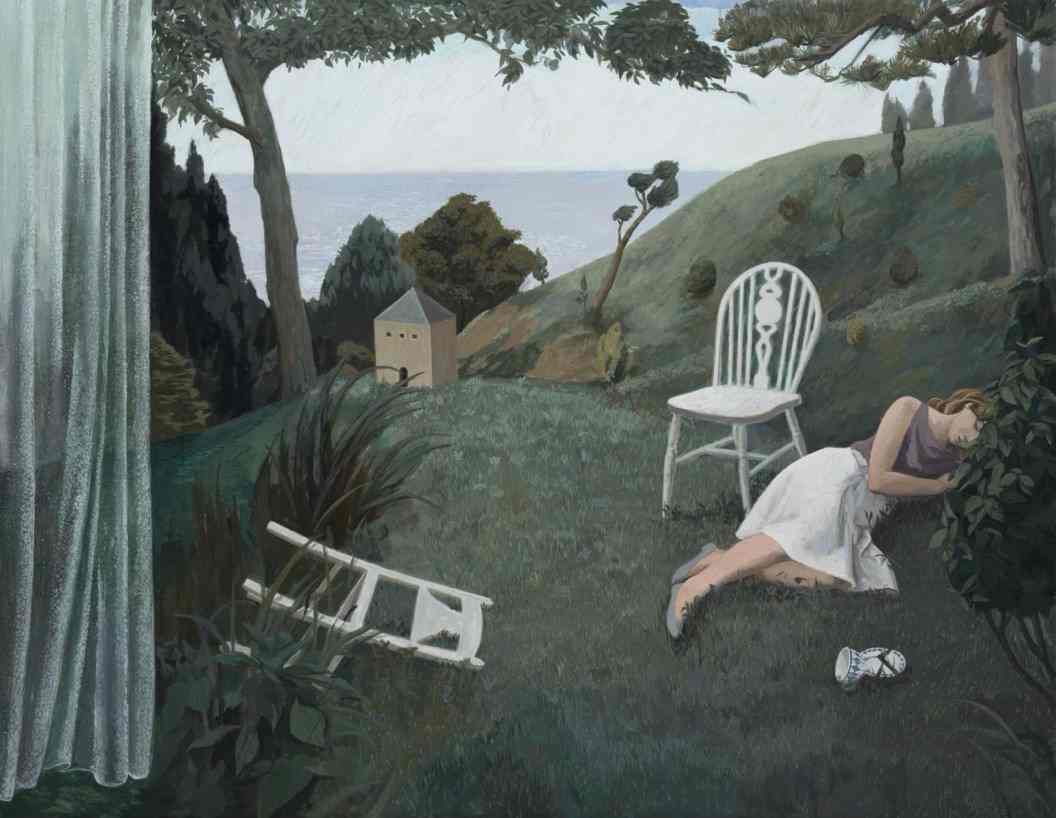
On the right side of the composition, a young woman lies on her side on the grass, her body half-hidden by shrubs; beside her are scattered broken teacups, with one white chair standing quietly not far away and another toppled in the grass. The curtain draping down on the left side of the image casts over this natural space a sense of being "watched," as if this were a carefully staged theatrical scene, in which even the figure resembles a quiet plant placed within the landscape. In her creative reflections, Jiang Dantong repeatedly speaks of nature: plants have no self-consciousness and simply grow freely according to their own nature and rhythms. When people enter nature, they too can temporarily set aside their endless questioning about position and meaning and become part of nature—this is precisely the state of life she yearns for. This work also reflects Jiang Dantong's response to the spiritual obsessions of modern people, and its title derives from Milan Kundera's work of the same name, Life Is Elsewhere. The French poet Rimbaud said: "True life is absent." We always feel alienated from and dissatisfied with our present life, placing our beautiful expectations on some distant place; yet when that distant place is finally reached, it will eventually shed the filter of imagination and become a new everyday reality. We rush about seeking answers, yet often overlook that we ourselves are the answer. Therefore, the tranquil and ideal natural landscape in Jiang Dantong's painting is both a concrete projection of "elsewhere" and a warning to pay attention to the "present."
Mocube held an extended conversation with the artist Jiang Dantong regarding this exhibition. In the following interview, "Mocube" is abbreviated as "M," and "Jiang Dantong" as "J."
M: In your paintings, small, everyday objects and fragments appear repeatedly—such as glass cups, parts of the body, plants, tables, and chairs. How do you usually capture these from everyday experience and transform them into painting?
J: I really enjoy being alone, or walking into nature. At such times, I gain a temporary calm that separates me from the world. My senses naturally open up and settle on what is before my eyes—on this moment, on things I had never paid attention to before. Ordinary objects are easily submerged in our habits because of their functionality. Yet in many such moments, they shed their original utilitarian character and instead become like witnesses—to how individual emotions surge beneath the surface, how thoughts and ideas shift. I look at it, and it looks back at me. It has not changed, yet meaning is being reshaped. In my creative process, I transform perceptible external landscapes—objects, space, nature—into projections and metaphors of individual experience.
M: Your paintings consistently carry a quiet, gentle quality, yet the core of the work actually touches on many weighty propositions. May I ask what core questions you have been focusing on recently that relate to this creative orientation?
J: Human beings are thrown into the world and must face choice, freedom, loneliness, finitude, death, and the uncertainty of meaning. No one can give you the answers. At such times, how should one settle oneself in this world? I know that nothing is eternal and everything will disappear, and yet I am still here living, watching, perceiving. It is precisely after realizing the finitude of existence that I try to find a way of being with the world—a place to dwell—by understanding and reinterpreting the perceptible things around me.
-
- Huang Huixian: The Phychic Drunken Boat
- 2026-09-24
In the group exhibition Supernova, currently on view at MOCUBE, Huang Huixian presents three works: Metamorphosis of the Golden Crow, The Psychic Drunken Boat, and Altar of the Moon Goddess.
Born in Guangdong, China, Huang Huixian received her BFA from the Sculpture Department of the China Academy of Art before pursuing an MA in Fine Art at the University of the Arts London in the UK. From sculpture to painting, her practice has retained a sustained sensitivity to material and space. In recent years, she has worked primarily with painting, while continuing to incorporate materials such as wood and mixed-media supports, giving her works a form that approaches that of objects, or even ritual implements. Bringing together Eastern mysticism, folk mythology, and personal memories and experiences, Huang develops a distinctive visual language through which she searches, within the movement of colour, for an underlying order latent in all things.
▌Introduction of Works
“Suspended in the depths of the cosmic sea, the Golden Crow melts its wings to clear new ground; the solar disc on the ancient wall erodes the slivers of light between the folds of time.”
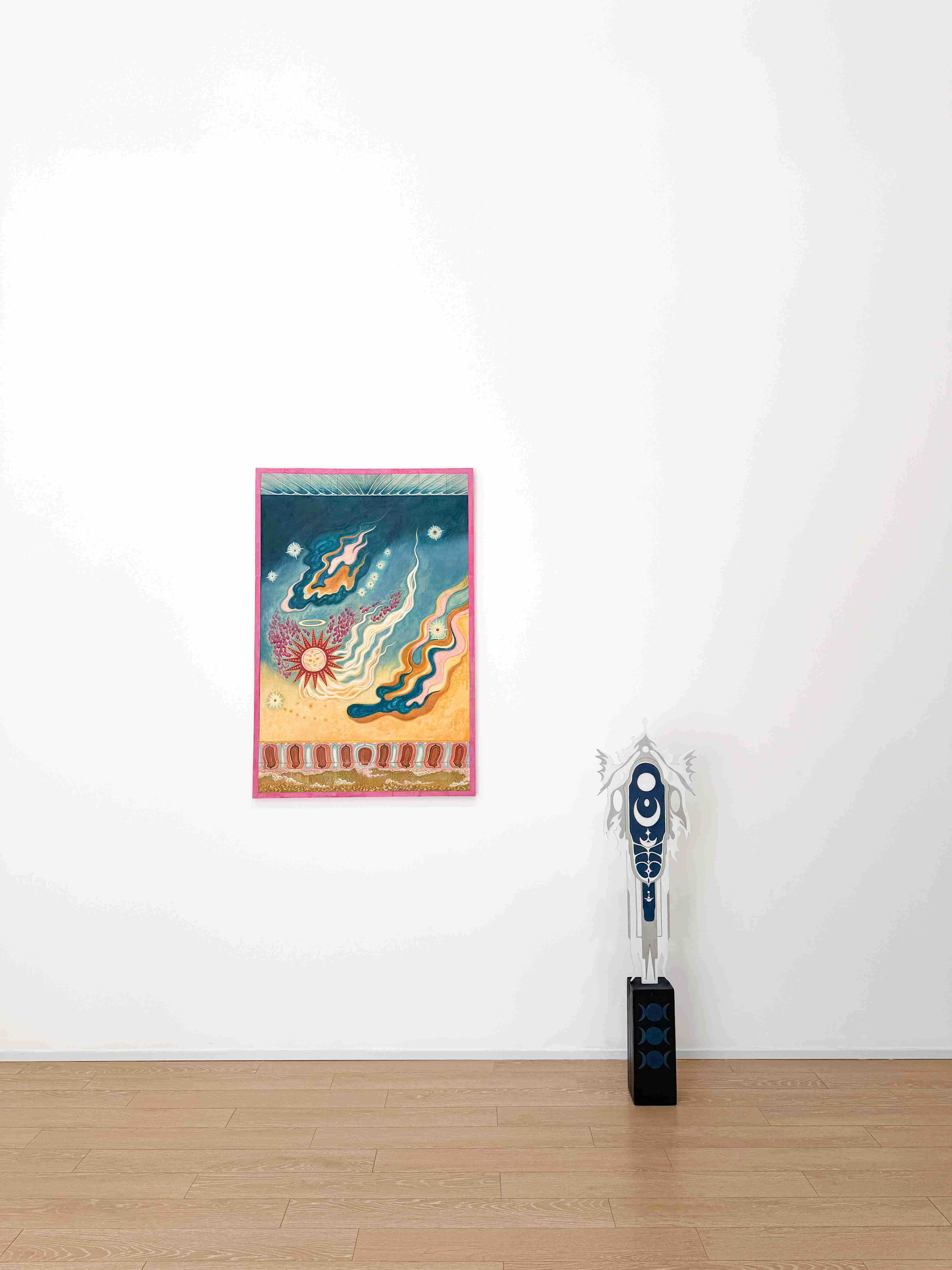
Metamorphosis of the Golden Crow unfolds from a golden solar disc. Flames and clouds expand around it, while forms in blue, pink, and gold drift through the air. The imagery draws on Huang’s understanding of Daoist thought. Reflecting on Laozi’s “attaining the utmost emptiness, maintaining profound stillness” and Zhuangzi’s notion of “sitting in forgetfulness,” she has spoken of how inspiration can re-enter only when consciousness temporarily withdraws from an excess of information and judgement. She compares this process to the incense smoke rising and dispersing from a Boshan censer, and to the crackle patterns produced during the firing of celadon. For Huang, creation always takes place at the threshold between “control and loss of control.” From this perspective, the seemingly free-floating flames, clouds, and celestial forms in the painting can be understood as myriad transformations slowly emerging from a state of stillness.
At the bottom of the work, Huang paints clouds, mountains, and geometric forms across several overlapping wooden panels, relating them to the Mount Sumeru pedestal of religious iconography. The Mount Sumeru pedestal not only supports sacred figures but also evolved into the lotus throne of Buddhist sculpture, becoming a field through which energy can be transmitted. Symbols inherited from ancient belief systems are continually reintroduced into contemporary experience in Huang’s work, becoming a means through which she engages with the order of nature as well as her own inner perceptions.
Altar of the Moon Goddess resembles an ancient ritual object set upright. Moon-phase-like symbols emerge successively within a deep-blue centre, while a silver-white outline extends outward on either side. Yet its point of departure is deeply rooted in everyday life: every year on the fifteenth day of the eighth lunar month, Huang’s mother would “worship the moonlight.”
Growing up surrounded by folk beliefs, Huang would accompany her family in lighting incense and making offerings to the gods on the first and fifteenth days of each lunar month. As a child, she did not understand the meaning behind these practices and simply participated in them. Later, while studying in the UK, and amid the uncertainty she experienced during the pandemic, she began to reconsider and question them: what has become of the once-significant tradition of worshipping the moon?
The work not only looks back to the ancient tradition of lunar worship, but also reconstructs a spiritual space in the present. In the past, people turned to the moon to pray for abundant harvests; today, we continue to gather with our families at Mid-Autumn Festival, wishing for lives of peace and fulfilment. Thousands of years later, people still seem to need a place where they can entrust their wishes.
The title The Psychic Drunken Boat comes from Arthur Rimbaud’s poem The Drunken Boat. Rimbaud believed that the poet must undergo a derangement of the senses, transforming oneself into a “seer” capable of reaching unknown realms.
From this, Huang writes: “The spirit medium compares herself to a boat; the boat, in turn, becomes the medium.” Just as the spirit medium departs from established perceptual orders, the boat in the painting seems to have lost its course, suspended in a boundless night. Several slender columns of white light rise from the boat, connecting it to scattered points of starlight. Rings of blue and yellow ripples spread outward across the water, while two dim moons hang in the distance. The frame surrounding the work is embellished with reliefs of wings, vines, and crawling creatures, further intensifying its dark, otherworldly atmosphere.
Here, “drunkenness” refers both to the literary associations of The Drunken Boat and to a state in which consciousness becomes temporarily loosened. Huang has long made a practice of meditating and burning incense before beginning a work, gradually entering a quiet inner realm. If the Five Elements, the I Ching, and astrological divination provide her with ways of understanding the movement and transformation of matter, meditation allows her to attend more closely to the subtle flows between time, breath, and perception.
The Psychic Drunken Boat is therefore also Huang Huixian’s artistic imagining of poetry, philosophy, and fate. Where the boat is headed is ultimately beside the point; what matters is that it remains perpetually in motion through changing states of perception.
MOCUBE spoke with artist Huang Huixian in an extended conversation on the occasion of the exhibition. In the interview below, MOCUBE is abbreviated as “M” and Huang Huixian as “H.”
M: You often combine painting and sculpture in your practice. The basswood panels in Metamorphosis of the Golden Crow and the frame of The Psychic Drunken Boat, for example, both demonstrate this approach. For you, how do these layers of material work together to ultimately form a complete field of energy?
H: To me, this represents a composite experience of being in the world. The forms and colours in my paintings are transformed from concrete experiences, while materials such as wood, panels, and clay used for carving or modelling each carry their own material memories—the grain formed through the growth of a tree, or traces accumulated in the earth over time. The imagery in a work corresponds to the manifestation of consciousness and narrative, while the composite materials evoke the physical body as a vessel that supports and carries. They are two sides of the same whole, resonating with one another.
The imagery releases emotions and symbols outward, while the materials point toward a deeper, more elemental energy. One expands as the other contracts, leaving space for breath between them. As our gaze moves back and forth between the flat surface of the painting and the three-dimensional elements, visual and tactile perception become interconnected. The dispersed forces gradually converge. This interaction between ourselves and the work collectively constructs an energy field that can be sensed and inhabited.
M: You have mentioned that before beginning a work, you meditate and burn incense to bring your mind into a state of clarity and emptiness before entering the creative process. During the actual process of painting, does this state of “emptiness” remain throughout? How do you maintain a balance between order and emotional fluctuation?
H: Before entering the creative process, meditation and burning incense serve as a ritual of cleansing, allowing me to temporarily set aside the complexity of everyday thoughts and arrive at a state of clarity and emptiness. But this “emptiness” does not remain unchanged throughout the entire process.
To me, “emptiness” is like a clean vessel. As the work develops, emotions, associations, and sensations arising from mythology and nature continually flow into this vessel. Fluctuation is inevitable. Order, meanwhile, forms the underlying framework. I see the movement of thought like flowing water, with a vital source that carries its own momentum. I allow it to follow its course and move with its natural direction, grounded in the initial state of stillness and emptiness within me, allowing feelings and thoughts to flow freely. At the same time, I rely on the visual logic, symbolic systems, and compositional rhythms I have developed over time to gather and contain the emotions and inspirations that might otherwise disperse.
M: Your practice brings together Eastern folk mythology, Daoist thought, and Western systems of mysticism such as Tarot and astrology. How do you bridge these different cultural traditions of the esoteric and integrate them into a single creative logic?
H: In my view, Eastern folk mythology and Daoist thought, as well as Western Tarot and astrology, may appear to belong to different cultural systems, but at their core they share humanity’s common questioning of cosmic order, fate, and the subconscious. This shared inquiry is the starting point of my practice.
In the East, Daoism speaks of qi, yin and yang, and the mutual generation of all things, while folk mythology preserves our ancestors’ imaginings of celestial and earthly deities and the spiritual forces of nature. Western esoteric traditions use celestial phenomena and symbolic imagery to explore the relationship between cosmic energies and human fate.
There is no single unified formula for these systems—just as every culture has its own distinct language. What interests me is their common underlying core: symbols, cycles of energy, and collective memory.
My creative logic is not divided according to geography or cultural boundaries. Instead, it takes the “connection between human beings and the cosmos” as its central thread. I bring together and rearrange symbols used across different civilizations to observe the spiritual world, placing them within the same narrative of energy. Eastern qi becomes the flowing ground, while Western symbols offer another dimension of observation; the two serve as points of reference for one another.
Throughout the long evolution of human intelligence, our ancestors have used different systems of divination and cosmological knowledge to understand and interpret the world. In contemporary society, can we reactivate and revitalize these spiritual systems, and through them more effectively re-establish a spiritual connection between ourselves and the ancient past, nature, and the collective unconscious?
-
- Chen Yun: Light, Like a Guiding Thread
- 2026-09-23
In the group exhibition Supernova, currently on view at MOCUBE, Chen Yun presents three works: The Third Room, The Unreached Realm, and The House of Yesterday.
Born in Ningde, Fujian Province, in 1993, Chen Yun primarily works with tempera. In the environment where she grew up, local traditional culture had long intersected with Western religious culture. Her later study of medieval and Renaissance frescoes, as well as church architecture and interior space, further shaped her practice. Over time, personal memories and lived experiences also entered her work, gradually forming the visual language seen in her paintings today.At first glance, Chen Yun’s paintings evoke a sacred architectural space through arches, walls, and doorways. Yet on closer inspection, one begins to notice traces drawn from everyday life: an old chair from Florence, a terrazzo floor associated with memories of her hometown, or even an inconspicuous piece of graffiti in the corner of a wall.As Chen Yun explains: “...When historical architecture became part of my visual vocabulary, what I began to explore was how an individual forms their own spatial memory through time.”Chen Yun first encountered tempera in a systematic way while studying at the Central Academy of Fine Arts in 2017. The ancient medium, with its slow process and successive layers, soon became a language she would continue to use over the years.She has described her practice as a process of “tracing back to the source.” In her earlier works, tempera was often used to articulate personal emotions and everyday objects. Later, churches, frescoes, and theatrical spaces gradually became recurring motifs, as these spaces allowed her to convey a particular sense of temporality. She also deliberately creates mottled surfaces, peeling textures, and scratches. For Chen Yun, these marks are ways in which time enters the image.
▌Introduction of Works
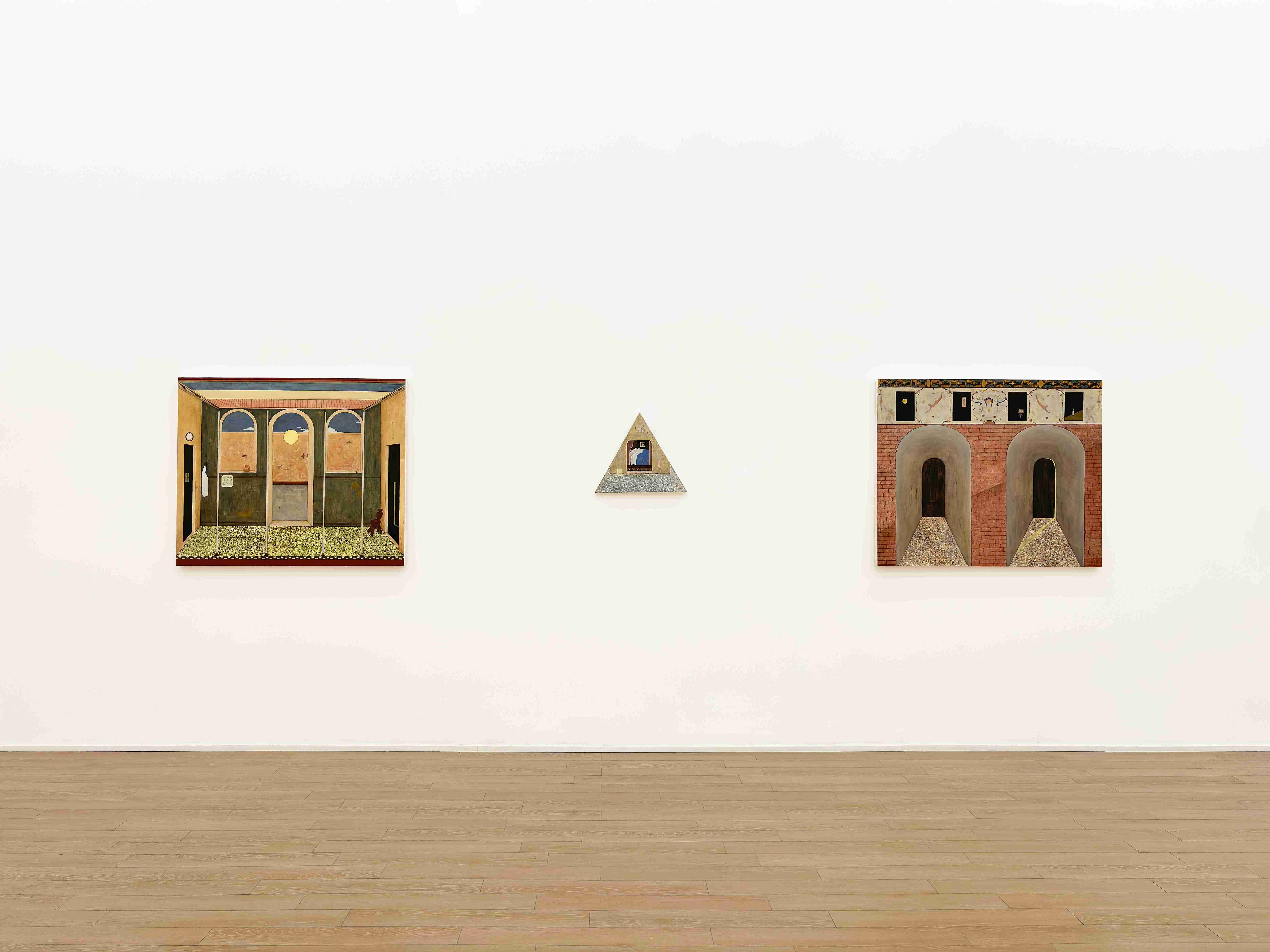
The House of Yesterday is one of Chen Yun’s recent works. Three arched openings extend the viewer’s gaze toward a distant sky and open landscape. Graffiti remains on the walls in the foreground, while the floor is covered in fine terrazzo patterns. A clock and calendar appear on the left, and an old chair stands on the right. Each of these details comes from a specific source. The chair, for instance, derives from an image Chen Yun photographed at the Bargello National Museum in Florence. Chen Yun has mentioned that the work also contains a tribute to Giotto. Giotto is often regarded as a pivotal figure between medieval and Renaissance art. In his work, religious painting began to bring the heavenly realm closer to the human world through more tangible architectural settings and a stronger sense of bodily volume. His approach to constructing three-dimensional architectural space on a two-dimensional surface has had a significant influence on Chen Yun. In his paintings, decoration and realism coexist with private memory and sacred space. The lines on the walls are particularly intriguing. Some relate to the murals of Dunhuang, while others were inspired by children’s graffiti that Chen Yun noticed while watching an archaeological documentary. Such casual marks on a wall allow a space already absorbed into “history” to reveal traces of the lives once lived within it. Perhaps “yesterday” does not refer to a particular day, but to the imprint that time leaves on each of us.
The Third Room takes an unusual triangular form, resembling an altar or a shrine. At its center is an intimate interior: a bed, curtains, a blue coverlet, and a small framed image set once again within the wall. As one room is nested inside another, the act of looking acquires another layer, creating a screen-within-a-screen structure. The triangular composition was initially inspired by a detail from a work by Fra Angelico. At the same time, Chen Yun reorganizes images and spaces that she has observed and collected over an extended period. The terrazzo floor in the foreground is distinctly ordinary and domestic, abruptly drawing the viewer back into a familiar realm of everyday life. In this sense, the painting also becomes a form of collective recollection. This sense of recollection also emerges through the weathered surface of the painting. As Chen Yun explains: “I have always been drawn to a certain sense of primitiveness. The slightly aged and rough quality of the surface allows me to feel the seriousness and simplicity of the ancients. It reminds me of Shaftesbury’s desire for people to understand Plato’s idea that all good art must possess seriousness and simplicity, rather than merely offering superficial visual pleasure.”
The Unreached Realm first draws the eye to two monumental arches, each leading toward a doorway in the distance. One is firmly closed, while the other stands slightly open. Across the upper section stretches a symmetrical band of ornamentation, bringing together the moon, candlelight, scrolls, and human figures—visual elements drawn from different regions and historical periods. Chen Yun has explained that the architectural elements above the doors draw on forms found in traditional Chinese woodcarving, while the architectural space itself references the Second Style of Roman wall painting, also known as the Pompeian Second Style. At the center of the ornamental band, a nude figure derives from the diver depicted in the ancient Greek Tomb of the Diver, a motif associated with the idea of being-toward-death. The relaxed poses of the figures on either side also reminded her of the bodies represented in the Baths of Caracalla. The lower section of the painting continues this process of recombining fragments. The linear drawing along the passageway on the left is based on sketches made by Michelangelo on the walls of Michelangelo’s Secret Room in Florence. On the opposite side, Chen Yun outlines motifs associated with traditional Chinese figure and landscape painting, creating a subtle dialogue between the two. Light is especially important in this work. From the narrow opening of the door on the right, a thin yellow beam enters the space diagonally. Though small, it alters the otherwise enclosed atmosphere. Chen Yun also regards “light” as an important keyword in this stage of her practice. In each work, a beam of light may enter the image, opening up another layer of virtual space.
Mocube and artist Chen Yun engaged in an extended conversation about the exhibition. In the following interview, “Mocube” is abbreviated as “M” and “Chen Yun” as “C”.
M: From the gold-leaf sun to the light filtering through a crack in a door, a certain presence of “light” emerges throughout this body of work. What particular significance does light hold in your visual language?
C: Light is like a guiding thread, drawing the viewer’s attention and imagination toward the space beyond the image.Recently, my interest in light has begun to shift. In my current paintings, it no longer carries a specific symbolic meaning. Instead, through its power to draw the eye, it sets an otherwise static space in motion. Particularly in my recent works, I have become increasingly interested in how to introduce light that draws the viewer’s gaze. A beam of light entering through a crack in a door, for instance, most directly prompts us to imagine another space beyond it. This space is hypothetical, yet it seems to gain a sense of existence through the very presence of that beam of light.For me, then, light is more like a condition that makes seeing possible. It lends a sense of time to walls, doors, floors, and even the most ordinary objects. The moment light appears, space seems to cease being merely an object represented in a painting and begins to enter into a relationship with the human body and memory.
M: You have long explored and drawn inspiration from religious and classical imagery. What new approaches have you taken in this latest body of work, and how do they differ from your earlier understanding?
C: In the past, I would place myself within an already established historical visual system and look through it—for example, through churches, frescoes, and classical imagery. At that time, I was more concerned with finding a way to connect with the past.Over the past few years, however, I have gradually come to realize that what truly interests me may not be the images themselves, but rather what remains after they enter my visual experience, and how they are transformed through that experience.These new works do not completely abandon my earlier interests in looking. Instead, they begin to introduce the question of “where I myself am situated.” The religious and classical imagery of the past has become a kind of visual memory embedded in my own experience of growing up. It is no longer simply something I draw upon as an object of observation and painting; it has begun to enter into a relationship with my own life, body, and memories of space.What I am now more concerned with, and actively exploring through my practice, is whether these visual experiences inherited from the past can give rise to a new kind of space within my own experience when they enter into the life of the present.
-

- The Buoy of the Previous Generation
- 2026-08-22
When I was still a student, I spent several winter and summer vacations living with Mr. Xu Junxuan. In daily life, Mr. Xu cared for me attentively, and on my artistic journey he continuously guided me. It was precisely through that close contact that I was unconsciously influenced by him, and that influence later became helpful to my own creative work. It was only afterward, when I came to understand Mr. Xu’s artistic lineage and development, that I gradually began to understand how he had grown from a student into a teacher, and how, through the lifelong pursuit of his vocation, he became a pivotal figure.
Mr. Xu joined the military when he was young and was a soldier. In 1957, he took the entrance examination for the East China Branch of the Central Academy of Fine Arts (now the China Academy of Art) and was admitted. From then on, he remained in Hangzhou, remaining at the academy. He studied under Mr. Ni Yide and Mr. Guan Liang, among others. These mentors were all pioneers of an artistic outlook that advocated the integration of Eastern and Western art during the early period when Western art entered China. Inheriting their ideas about combining oil painting with Chinese traditions, Mr. Xu devoted himself to this direction both as an educator and as an artist after graduation.
In 1960, the Romanian artist Eugen Popa organized the “Popa Oil Painting Training Class” at Zhejiang Academy of Fine Arts. Mr. Xu was admitted to this training program and studied under Professor Popa for two years. During this period, he not only received technical training but also expanded his understanding of art. At the same time, he was deeply encouraged and inspired by Popa’s concept of “Chinese oil painting.”
Mr. Xu’s artistic career spanned the period of construction after the founding of the People’s Republic of China and the era of reform and opening up. He was active during the period when popular art served workers, farmers, and soldiers, and also lived through the eve of the explosion of contemporary art. His artistic experience began and ended at the two ends of a new era and new developments; precisely because of this, the several decades in between are easily overlooked. Within a particular historical context, he continued to create many vivid works despite circumstances that were not always favorable to his artistic ideas. The thoughts embodied in those works remain moving even today. He neither completely accepted everything around him nor recklessly rejected it all. As an artist, he carefully preserved his own creative principles. Only when his work is restored to its historical context can we better appreciate his talent.
When people focus on the great era at the beginning of the twentieth century, when Western influences flowed into China like a rising tide, and on the magnificent diversity of contemporary art after the 1980s, we must not forget those buoys that existed amid the great currents and turbulence during the transformation of Chinese art toward contemporaneity. Mr. Xu and a group of artists with similar experiences were often hidden figures in this process of development. People could vaguely sense their presence, yet could not clearly say who they were. They are a true representation of a particular historical period and of a transitional generation.
A few additional fragments and trivial memories about Mr. Xu’s humor and “Xuan”
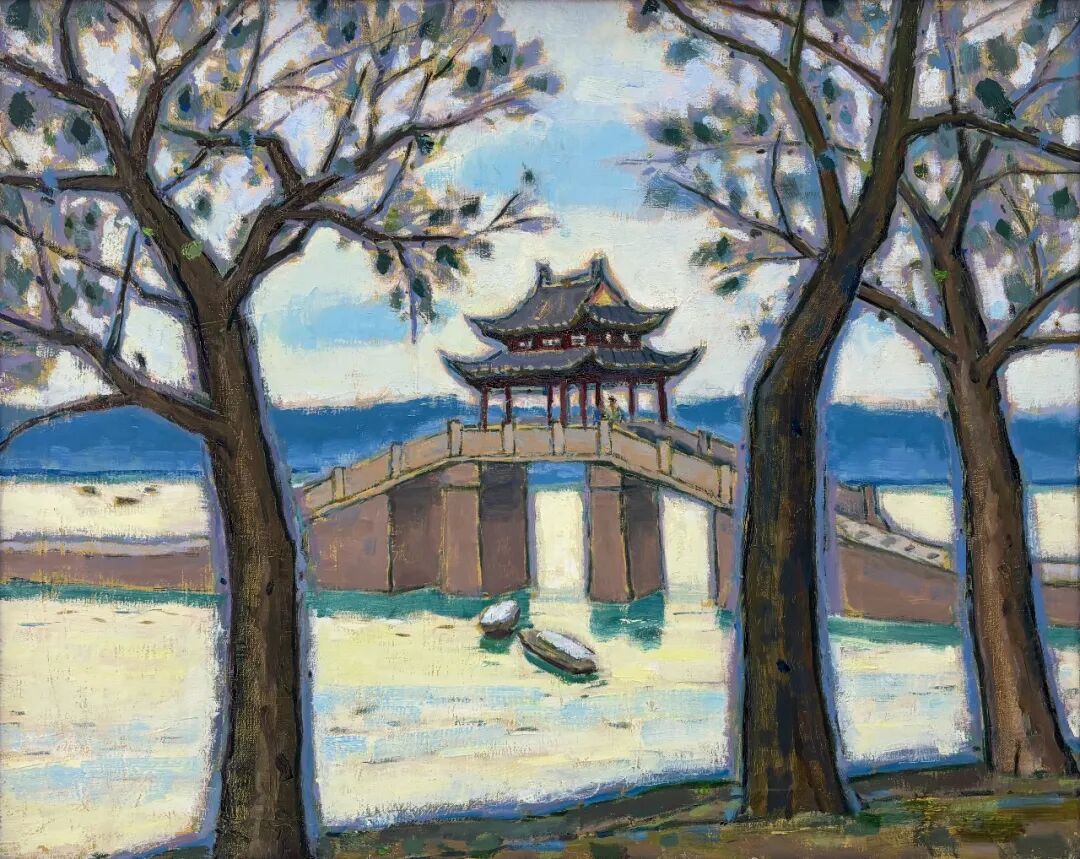
At home, Mr. Xu seemed to almost never talk about art unless you took the initiative to discuss it with him. He also never really taught you anything, and I never saw him make sketches. It seemed as if he finished his work in the studio, returned home, and then became very quiet. On the wall directly facing the entrance of Mr. Xu’s home hung a still-life painting titled Flowers in A Vase. It was a calm, almost flat depiction: red and white flowers placed in a white porcelain vase. The style clearly carried the same qualities found in Guan Liang, Ni Yide, and Pang Xunqin—a simple, classical, and scholarly sense of flatness.
At that time, Mr. Xu’s studio was on the second floor above the academy’s academic affairs office. During summer vacations, we often went there to visit. He seemed to paint very slowly, and he repeatedly revised his works. He would paint something, put it aside, then take it out again later and continue working on it. I rarely actually saw him move his brush; perhaps his movements were simply very subtle. Every time we visited, Mr. Xu always hoped that we would give him opinions—yes, the more we said, the better. Sometimes, when we truly had nothing more to say, we would desperately squeeze out a few comments just to complete the “task,” mainly because after finishing it, we could look through his works and see what new things he had created.
Mr. Xu often said that his paintings depicted things that could not be seen in reality, and that their perspectives were imagined. Later, I remembered the Jieziyuan that I had copied as a child. Looking again at traditional Chinese painting, I realized that perhaps this was exactly how it worked. The Jieziyuan consists of various individual elements: mountains, water, trees, houses, figures, and so on. Each is presented separately. One then finds a perspective of “traveling within a painting” or “wandering in the imagination” and combines these elements together. Different combinations create different realms, depending on one’s artistic vision.
Mr. Xu did not use many adjectives. For every delicious dish, he would only use one word to praise it: “xian” (fresh, delicious). Because of his accent, he always pronounced this word as “Xuan¹ ,” the same sound as the “Xuan” in his name. So we often imitated him, saying, “Ah, this dish is so Xuan.” He also called people and paintings he admired “interesting.” I do not know where this adjective came from, but once we became accustomed to it, we often joked with him: “Ah, this dish is so interesting; this painting is so Xuan.”
¹ In dialects, "xuan" also carries the meaning of "loose and soft," commonly used to describe the texture of soil or food.
Text by Lou Shenyi
-
- A Conscientious Teacher
- 2026-08-07
Teacher Xu Junxuan's painting exhibition has finally opened — modest and understated. Looking at the photos, a butterfly came fluttering in at the opening and landed on the foreword panel, which brought to mind folk tales, and also many happy and unhappy memories from within the Oil Painting Department...
Seen from an outsider's perspective, Mr. Xu occupied a low position in the department's invisible hierarchy of prestige. Although he had been a volunteer soldier and had served in Korea, wearing an old, faded military uniform in protective coloring, he was always cautious and careful — whether this was due to differing academic views or interpersonal politics, it's hard to say. The stars of that era were teachers of the Soviet school or those who had studied in the USSR, who felt good about themselves with their bold brushwork and exotic color sensibilities.
In the early 1960s — so I've heard, and everything below is hearsay — the Central Academy of Fine Arts had once considered inviting the Soviet painter A. A. Mylnikov to run a training class, just as they had done with the Maksimov class years before. But times had changed, and Sino-Soviet relations had deteriorated. So instead they set up a class led by Luo Gongliu, who had studied in the USSR; the major works of teachers like Zhong Han and Du Jian emerged from that period. Zhejiang Academy of Fine Arts, which also fell under the Ministry of Culture, invited experts from Eastern Europe — Romania — instead. It's said the Romanian training class was originally meant to be led by Baba, but Baba himself had come under scrutiny and criticism at the time, so the Romanian Artists Association sent Popa to Hangzhou instead. Teacher Xu took part in this training class. At the time, there were regulations from above that outsiders were not allowed into their classroom. The classroom was on the third floor of the Oil Painting Department, the westernmost room. The selected students were all politically reliable young teachers from Tianjin Academy of Fine Arts, Sichuan Academy of Fine Arts, and Zhejiang Academy of Fine Arts. Sometimes lecture notes had to be handed in and were not allowed to circulate. Older students at the time secretly went to peek in twice during lunch break. That was a period when the country was in the midst of opposing "revisionism," and there was a strict set of regulations governing the Eastern European experts who came. The political campaigns eventually caused the course to fizzle out unresolved, and then the Great Revolution began...
After the Great Revolution ended, Teacher Xu and Teacher Jin Yide began teaching in the First Studio of the Oil Painting Department, incorporating some of the experience from the Romanian training class into the teaching program. There followed a period of relative openness. The First Studio was led by Mr. Wang Liuqiu, and in essence it carried forward the purity of the traditional creative approach of older masters like Lin Fengmian, Guan Liang, Ni Yide, Yan Wenliang, and Hu Shanyu. For the first time in the Oil Painting Department's teaching, it paid attention to and respected individual aesthetic orientations, allowed non-uniform artistic styles to emerge, and offered diverse paths for artists' growth — creating a rare and valuable academic environment. The teacher roster at the time included: Wang Liuqiu, Ma Yuru, Jin Yide, Xu Junxuan, Chen Aikang, Hu Shanyu, Lin Dachuan, and others. By the standards of extreme-left artistic doctrine, the visual aesthetics of these teachers all carried, to some degree, a whiff of political incorrectness. And by Soviet-school standards, their paintings lacked the solidity, weight, and refined, exotic color sense that was prized. At the time, students from different graduating years in the First Studio all studied together in the same classroom. The students then included: from the senior-most year, Wu Shan and Hou Wenyi; from the second year, Zhang Peili and Wang Guangyi; and from the year after that, Geng Jianyi, Wei Guangqing, Liu Dahong, and others. This group of artists, now major names on the contemporary art scene, stands as proof of just how special the First Studio was. Around 1980, Teacher Xu maintained fairly close personal friendships with several once-prominent but then-fallen-on-hard-times great artists — Zhou Changgu, Guan Liang, Yan Wenliang, Hu Shanyu, Lin Dachuan, and others — and would kindly bring his students along to visit them. The artist Wu Shan has always remembered the scene of Teacher Xu Junxuan taking them to visit Mr. Yan Wenliang: in the 1980s, Yan felt out of step with the times, and utterly endearing for it. I, for my part, always remember Teacher Xu taking us to Shanghai to visit Mr. Kong Boji, and inviting teachers like Shu Chuanxi and Hong Shiqing to the school to give us special small-group lectures.I studied oil painting for a year under Teachers Xu Junxuan and Wang Chengyi, and later worked in the Printmaking Department, right upstairs from the Oil Painting Department — many colleagues and friends, simple and relaxed relationships.
I interviewed a number of senior schoolmates and artists, and pieced together these bits of background information. As for Teacher Xu Junxuan's artistic achievements, please read Mr. Dai Zhuoqun's curatorial statement — it is fair-minded and even-handed, a fine piece of writing.
Text by Liang Quan
-
- Interview | Guo Haiqiang: Clouds Linger Across the Qinling Mountains
- 2026-06-26
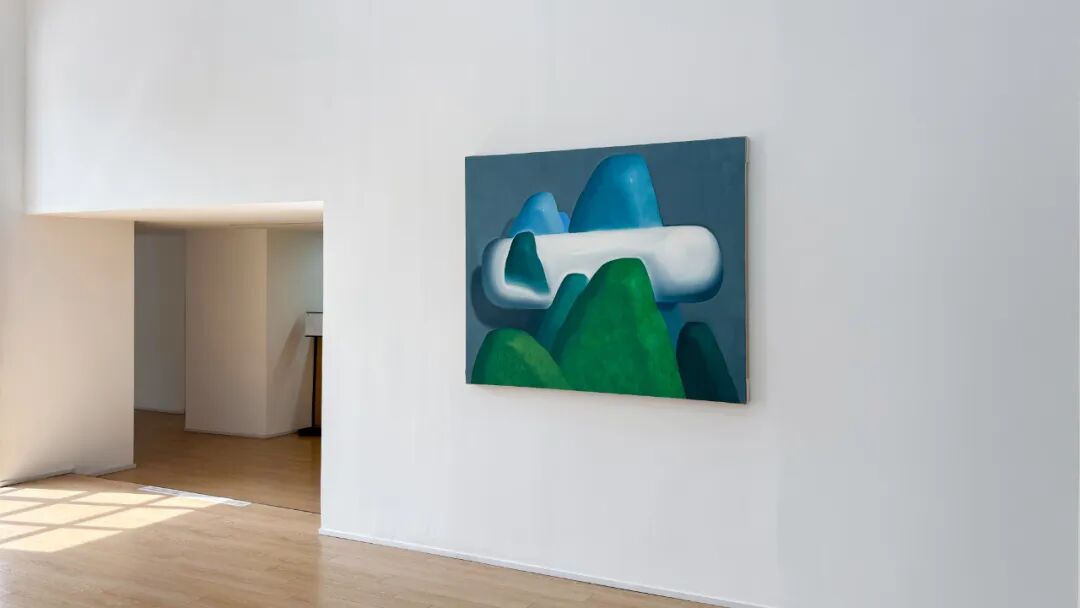
Mocube is currently presenting Lingering Clouds, a solo exhibition by artist Guo Haiqiang. The exhibition marks a significant milestone in the artist’s long-term engagement with the Qinling Mountains, and reflects a deeper contemplation of time, nature, and lived experience through his sustained landscape practice. This conversation revolves around the origins of Lingering Clouds, the significance of the Qinling Mountains as a site of artistic production, and the ways in which painting emerges through acts of observation, walking, and dwelling. Throughout the interview, we explore how the artist transforms his enduring encounters with landscape into a visual language shaped by time, perception, and presence. In the interview below, Mocube is abbreviated as M, and Guo Haiqiang as G.
M: "Lingering Clouds" is borrowed from a poem by Tao Yuanming. The phrase later became the title of this exhibition. How do you understand the meanings of "lingering" and "clouds" in this context? How do they relate to your artistic practice in recent years?
G: The exhibition borrowed the title Lingering Clouds from Tao Yuanming's poem Lingering Clouds (Ting-yun). This is not simply an attempt to emulate the ancients in pursuit of transcendence or detachment from the mundane. Rather, it is the phrase "lingering clouds" itself that succinctly and profoundly points to the exhibition's theme. These two characters possess a remarkable vitality: the movement of clouds responds to the stillness of mountains; clouds are what bring mountains to life. For many years, mountains have been the focus of my work. I enjoy condensing the forms of mountains and the vitality of clouds into a unified, primordial, and complete whole—a state of quiet contemplation. I seek to suspend time itself, allowing the clouds to come to rest. Perhaps, when the clouds stop moving, they become eternal. As Li Bai wrote, "Mountains rise before one's face; clouds emerge beside the horse's head." This is the relationship between clouds and mountains. I have no interest in simply imitating how the ancients depicted them. Instead, I prefer to enter the mountains themselves and paint my own genuine experience. To borrow Shitao's words: "I am myself because there is a self within me; the eyebrows and beard of the ancients cannot grow upon my face, nor can their innermost organs be placed within my body." I am creating my own clouds and mountains. Su Shi once remarked: "The great painters of antiquity were never ordinary people; their wondrous imagination sprang from the same source as poetry." Faced with the poetry and paintings of the ancients, I ask myself: what have I been doing all these years?
M: In the exhibition tour video, you mentioned that the phrase "clouds stretching across the Qinling Mountains" resembles the single horizontal stroke (yi heng) in Chinese calligraphy. How has your experience with calligraphy informed the way you conceive and depict clouds in your work?
G: One.
M: You often speak of measuring with the entire body. In relation to this group of works, what specific role does the body play in the process of painting?
G: The moment one enters the mountains, they confront the body directly. Looking at photographs or moving images is an entirely different experience. That is why I speak of measuring with the body. I measure the height and depth of mountains with my legs. I measure the scale of a painting with my entire body. The dimensions of these works correspond precisely to the span of my outstretched arms moving through space. In other words, the scale of the paintings is comparable to the scale of the human body. From a painter's perspective, this is a comfortable size to work with. If one wishes to depict mountains on a monumental scale in order to convey grandeur, one must climb ladders and stand on platforms. But that is not what I am interested in doing at present. Every scale of painting establishes a different relationship with the body. Should one prioritize the tangible object (wu) or the underlying principle (li)? These paintings seek a balance between the two.
M: In your earlier works, you often broke beyond the boundaries of the frame and even incorporated actual materials from the mountains and forests. In this new body of work, however, most pieces are completed within the frame. How do you understand this “reduction” or “subtraction” of materials?
G: Inside the frame and outside the frame. What can be contained within the frame, and what exceeds it—I regard this as a philosophical proposition. I spent several years working outside the frame, and then several more years working within it. This is one of the fascinating aspects of making art. As an ancient text states: "Heaven and Earth are the parents of all things. When gathered together they form a body; when dispersed they become beginnings. So long as form and essence remain intact, transformation remains possible."
M: As an artist trained in sculpture, how do you understand the sense of “sculpturality” in this body of work? How does it differ from your earlier approach, which emphasized material accumulation and relief-like surfaces?
G: Whatever one's training, one inevitably carries certain habits. I call these habitual tendencies. Throughout my work in recent years, I have followed these habits while constantly correcting them. When material accumulates on the picture surface, it begins to resemble sculpture or relief. Yet painting has its own language, distinct from sculpture. Just as sculpture and a sculptural quality are two different concepts, painting must remain true to its own means. In this exhibition, the works within the frame are executed through purely painterly methods on canvas. They represent my current reflections and experiments concerning the language of painting itself.
M: Over the years, your way of working has changed significantly: cycling into the mountains, sketching on site, then returning to the studio to rework the images; moving from oil pastels and small-scale works to oil painting and larger formats, with both materials and scale constantly shifting. Yet the Qinling Mountains have remained unchanged throughout. Why is it ultimately the mountains and clouds that persist?
G: In 2013, I first rode a bicycle into the mountains to paint from life. For ease of transport, I worked on a small scale, using oil pastel on paper. Many of those early works could be completed on site. After several years, however, I realized that painting from life alone was far from sufficient. I began bringing the works back to the studio, returning to them repeatedly and contemplating them over time. As time accumulates, so too does thought. Now, thirteen years have passed. Time flies, the seasons continue their endless cycle, yet the mountain remains unchanged. As the poem says: "The mountain flowers fall away, yet the mountain endures; waters flow on in emptiness, while the mountain remains at ease."
M: Your paintings often carry a sense of heaviness and slowness. What is the relationship between this rhythm and your way of living?
G: The kind of painting I practice is traditional, even old-fashioned. It requires time. The act of painting itself is imbued with a sense of duration. I use time to paint time. What matters is the time I devote to painting. What matters is time itself.
M: You once said, “The mountain is my studio.” After more than a decade of continuously engaging with the same landscape of clouds and mountains, what do you feel you are truly trying to paint—is it the mountain, time itself, or something else?
G: My paintings arise from direct encounters with nature and from lived experience, yet I do not seek to depict natural scenery. For this exhibition, I approached pictorial composition through the structural principles of Chinese calligraphy. A single square Chinese character contains an entire conception of the universe and of space. Each character is a world unto itself. Even the character yi(一, one) constitutes a complete world. When this understanding enters painting, its meaning changes. It is no longer merely a segment of cloud, but the totality of cloud itself. In the mountains, I enjoy quietly observing the mountains and the clouds. In the studio, I enjoy slowly contemplating my paintings. In this way, the heart finds a place to rest. Painting is my way of life. It is a way of being in the world. I think through painting, and I live through painting.
-
- Art Fair | ART021 SHANGHAI 2025 | BOOTH E10
- 2025-11-09
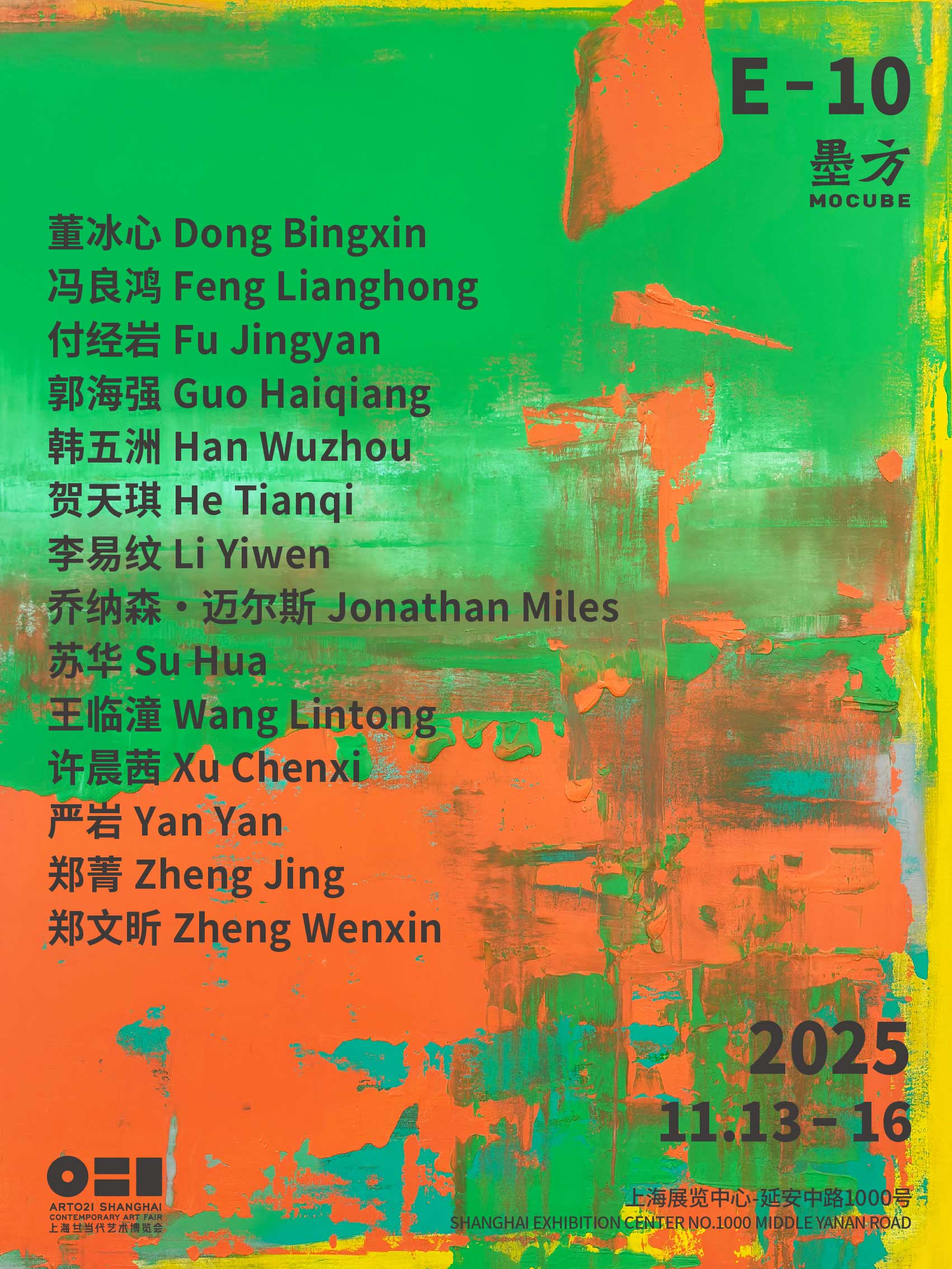
For ART021 Art Fair,Mocube (Booth E10) will present latest creations and representative works by Dong Bingxin,Feng Lianghong,Fu Jingyan,Guo Haiqiang,Han Wuzhou,He Tianqi,Li Yiwen,Jonathan Miles,Su Hua,Wang Lintong,Xu Chenxi,Yan Yan,Zheng Jing,Zheng Wenxin.
VIP Preview
2025.11.13 (Thu.) 11:00 - 20:00
2025.11.14 (Fri.) 13:00 - 20:00
Public Days
2025.11.15 (Sat.) 11:00 - 18:00
2025.11.16 (Sun.) 11:00 - 18:00
Location
Shanghai Exhibition Center - Gate 2, No.1000, Middle Yan'an Road
-
- Exhibition Review | A Mistaken Entry into "Tao Hua Yuan"
- 2025-09-06
I had originally planned to visit Mocube with Gary and Kris to see Li Yiwen's exhibition. But upon arrival, we found the poster at the entrance had been replaced with “Han Wuzhou: A Snowy Day." Peering through the glass, the interior was dimly lit with shadows moving about, yet the gallery door remained tightly shut, leaving only a narrow crack. When we pushed the door open, we discovered the space was already packed with people—some even sitting on the floor. It felt as though we had stumbled into a sealed miniature world. The moment the door closed behind us, reality seemed to shift in an instant.
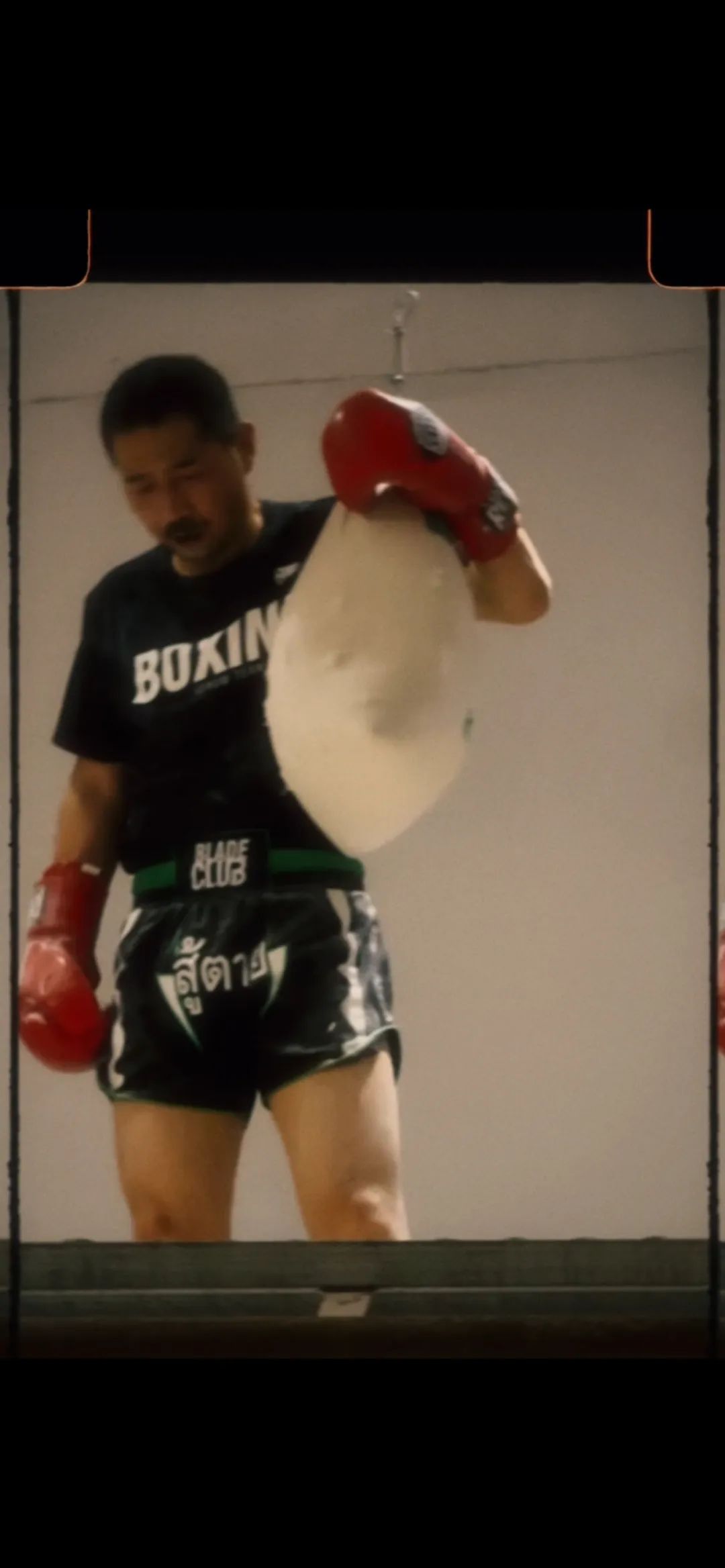
What came into view was an artist standing on the second level of a scaffold, striking with full force at three suspended sacks of flour — each marked ‘25kg,’ their total weight roughly equal to his own. With every blow, a cloud of white powder burst into the air, slowly drifting through the space like snow or mist, settling on the withered trees and ground below. This was Han Wuzhou’s performance piece Tao Hua Yuan. We stumbled in halfway, unwittingly becoming a footnote to this ‘accidental entry into the Tao Hua Yuan.’
The Poetic Confrontation Between Body and Matter
Han Wuzhou uses his 150-jin (roughly 75kg) body to oppose an equal weight of flour — a pure dialectic between body and material. The act of striking becomes a metaphor: the labor, pain, and dissipation of the human body, in cyclical tension with the repeated collisions and drifting of inert matter. As the flour turns into dust, it gently falls, covering the withered branches on the ground, creating a “snow scene” that is both pure and tranquil, yet mournful and desolate. This “snow” does not descend from nature; it is an illusion summoned by the artist through physical exertion — symbolizing the consumption of life, the traces of illness, and an aesthetic sublimation of suffering.
On the withered branches beneath the scaffold, red pills are scattered like flower buds that cannot bloom — a spring that never arrives. These suggestions of unfinished lives imbue the entire installation with a sense of unfulfilled hope and slow, creeping despair — much like the way flour covers the branches of life: it conceals, but cannot heal.
The performance lasted for half an hour, during which Han Wuzhou, with a body growing steadily more exhausted, built a silent tension through his diminishing rhythm. His performance was not merely an accumulation of “actions,” but a practice of “edge-living” — a simulation of the limits of life that the audience could almost physically empathize with. In this process, the body’s breakdown echoed the dispersion of the flour, forming a spiritual cycle from flesh to matter, from awareness to concept. As the flour returned to dust, the artist also reduced himself to a vessel of perception, enabling the audience to experience a shared resonance in the falling “snow,” rather than remaining mere spectators.
This transformation evokes Zhuangzi’s words: “From the perspective of what does not change, all things and I are one and infinite.” Through this act of utter exhaustion, Han Wuzhou transforms individual suffering into a shared, cosmic experience of empathy. He detaches illness from the private realm, turning it into a philosophical perception within a public context. It is neither a protest nor a narration, but a silent ritual — one that achieves the poetic transcendence of pain.
Subtle Metaphors of Medicine, Green, and Culture
Han Wuzhou’s practice consistently revolves around “medicine” as a modern material experience. At A Snowy Day, red pills hang from withered branches — resembling flowers or fruit, yet arrested at the point of budding. They are no longer pharmacological entities nor objects within the medical system, but are instead imbued with cultural and emotional reinterpretation. Within the experience of illness, they serve as vessels of pain and hope; within art, they become silent yet powerful verses of poetry.
From Pomegranate, after Xu Wei (2021) to A study in pink medicine (2023), and now Caregiving (2025), Han Wuzhou has consistently explored the metaphor of life through the color green. In A Snowy Day, this green does not appear overtly, but is expressed through the act of concealment as flour falls, and through the way pills hang from branches. This hidden green represents life’s resistance under the weight of illness — a coded language embedded within the cultural context.
The green as Han Wuzhou understands it may be traced back to the Chinese literati tradition’s “will to live” — not a symbol of rebirth as in the West, but a subtle, resilient force of life that penetrates illness. It echoes the cool, ethereal spirit of Wei-Jin metaphysics, and the quiet voids between brushstrokes in Song and Ming painting. Through the metaphors of medicine and color, Han constructs a bridge between personal experience and historical consciousness, transforming contemporary trauma into part of cultural memory.
From Action to Co-being: A Contemporary Ritual
As a piece of performance art, A Snowy Day is not only an enactment of the body and material—it is also a ritual jointly completed by the artist and his audience. Han Wuzhou does not perform in isolation; instead, he constructs an open field of experience, where the breath, exhaustion, and sweat of the artist merge with those of the viewers, forming a shared perceptual community around this “snowfall” event. What he evokes is a deep bodily memory and psychological resonance: the stillness of snow, the dependency on medication, the fragmentation and reconstitution of life—all flowing silently, passing from one body to another.
The power of this work also stems from his re-signification of materials. Pills, flour, withered branches—seemingly ordinary objects—are transformed in Han’s hands into mediators of emotion and culture. He does not construct grand narratives, but instead weaves a metaphorical web of individual existence through the most mundane elements. Here, material no longer functions as external symbol, but becomes an inner form, fused with the artist’s embodied experience.
With A Snowy Day, Han Wuzhou responds to the possibilities of performance art in the contemporary context—not as spectacle, nor as conceptual representation, but as a space of mutual openness between body, matter, and culture. The “snow” in the title is not snow itself, but snow as art, snow as pain, snow as the fine dust where memory and forgetting intertwine. He pushes the body to its limits, and in the swirling mist, summons a long-suppressed aesthetic sensitivity—allowing us, in a sudden snowfall, to glimpse what it means for life to dissipate, and for will to fall silent.
-
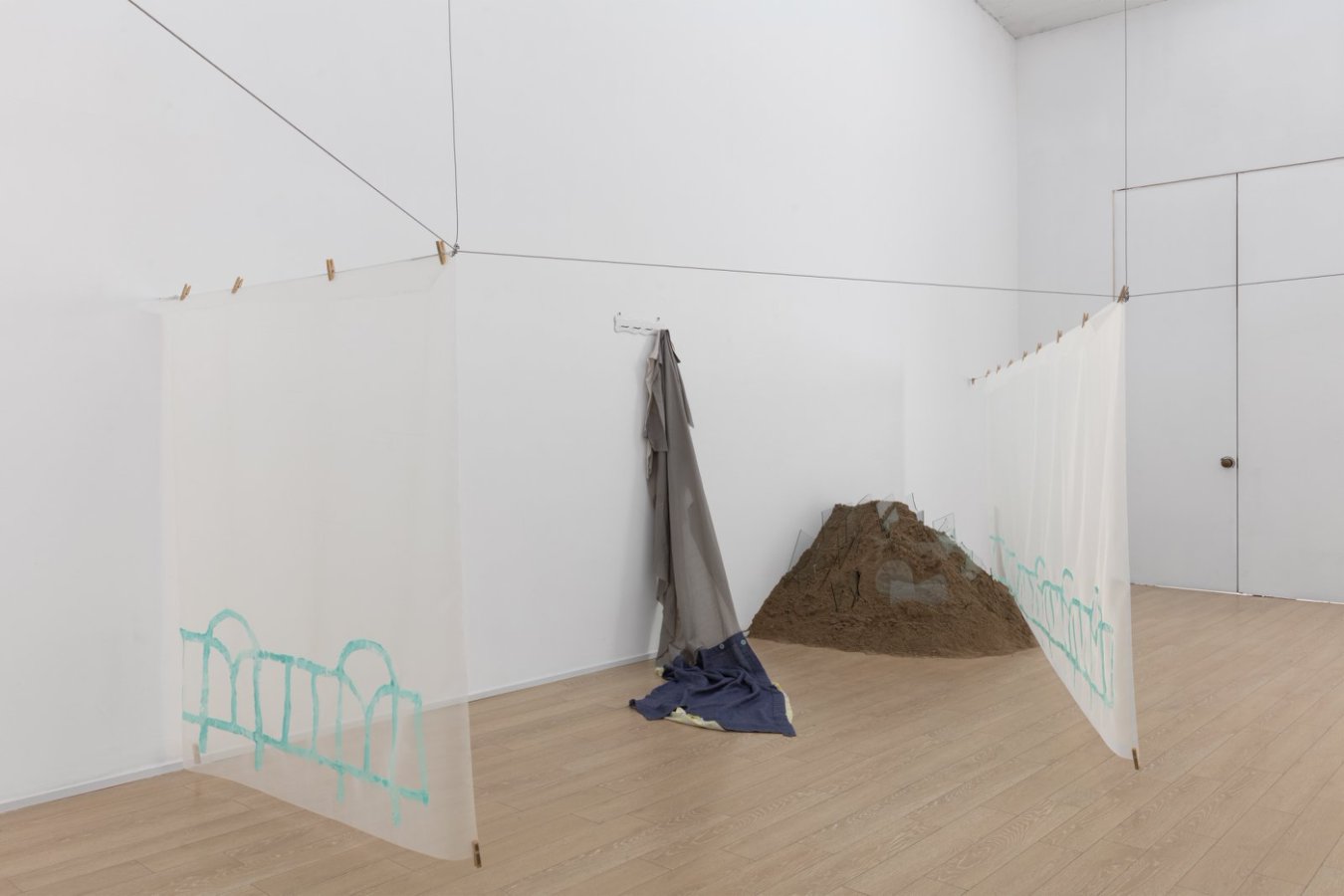
- Review | Li Jia: On The Summer of Dalniy
- 2025-09-06
-
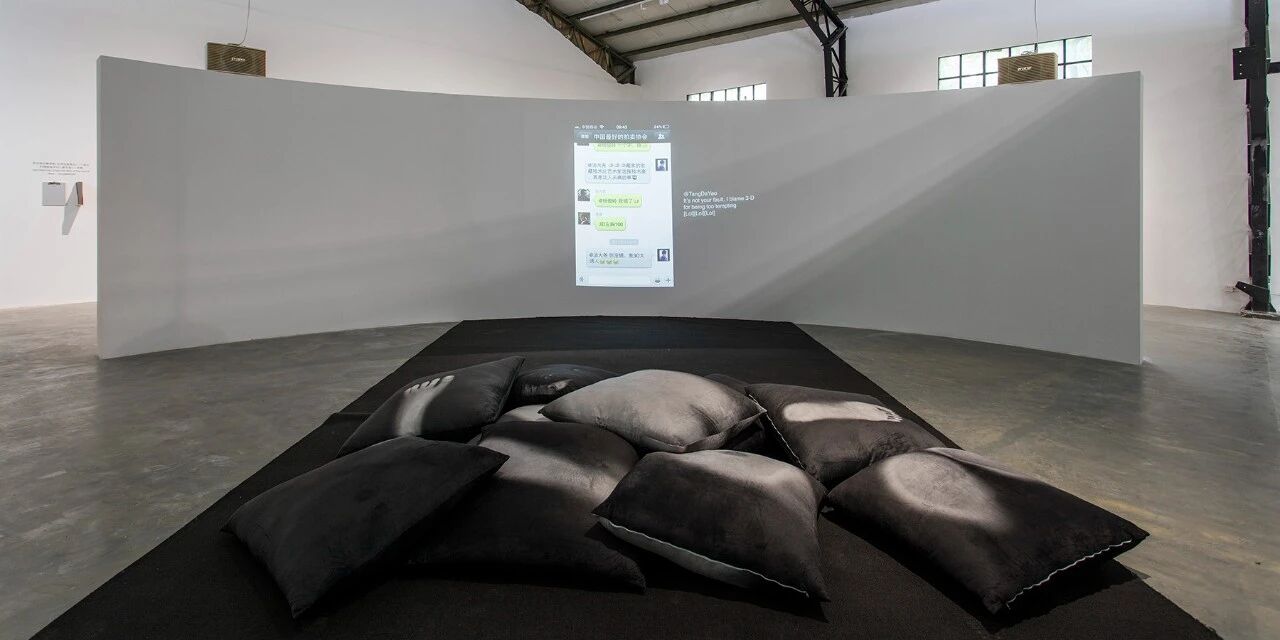
- Artist News | Zhu Tian’s Work Added to the Permanent Collection of the Centre Pompidou
- 2025-09-06
The works of Zhu Tian, Selling the Worthless and Scan, have been included in the permanent collection of the Centre Pompidou in France. This acquisition is supported by the Chanel brand, and 21 works by 15 emerging Chinese artists have been added to the permanent collection. With the addition of these 21 pieces, the Centre Pompidou's collection of Chinese contemporary art has been substantially expanded, marking an important supplement to the existing collection and highlighting the Centre Pompidou’s ongoing focus on contemporary Chinese art.
The 15 Chinese emerging artists selected by the Centre Pompidou were all born in the late 1970s to early 1990s. Themes such as China’s opening-up, environmental changes, and shifts in social lifestyles are central to the works of this younger generation of artists.
-
- Zhu Tian: A Long Defeat “Discoveries” sector of Art Basel Hong Kong
- 2025-04-22
Mocube is pleased to announce that we will present artist Zhu Tian’s solo project A Long Defeat in the “Discoveries” sector of Art Basel Hong Kong from March 26 to March 30, 2025.
A Long Defeat is a project conceived specifically for Art Basel Hong Kong 2025, bringing together performance, installation, video, text, and sound to address the intellectual and cultural crises of our time. The title refers to an apparently impossible but noble struggle. In Zhu Tian's view, human history can be seen as a series of ‘long defeats’, with life itself being one against the inevitability of death. At the core of the project is a performance that reimagines the myth of Narcissus in a contemporary context—not as a simple tale of vanity but as a meditation on identity dissolution. It involves two synchronised performers, reflecting on modern narcissism, and its consequences—in particular, the inability to love beyond the self. This is accompanied by a sound piece composed by Zhu, layering electronic music with a storytelling of the Chinese mythological ghost tale The Painted Skin. The installations extend this exploration. Et in Arcadia Ego engages with the paradox of the Ancient Greek philosophical maxim about ‘self-knowledge’ and its modern implications, while SAD — an installation built from artificial sunlight lamps—plays on the dual meaning of ‘SAD’ as both a product for combating seasonal affective disorder and a metaphor for contemporary discontent, where it commodifies happiness, promising illumination while masking deeper unease. By engaging with these themes, the project seeks to rupture the smooth, frictionless experience of contemporary selfhood, offering instead a space where the audience might confront their own image—not as validation, but as a site of rupture, uncertainty, and, perhaps, the rediscovery of the ‘other’.
-
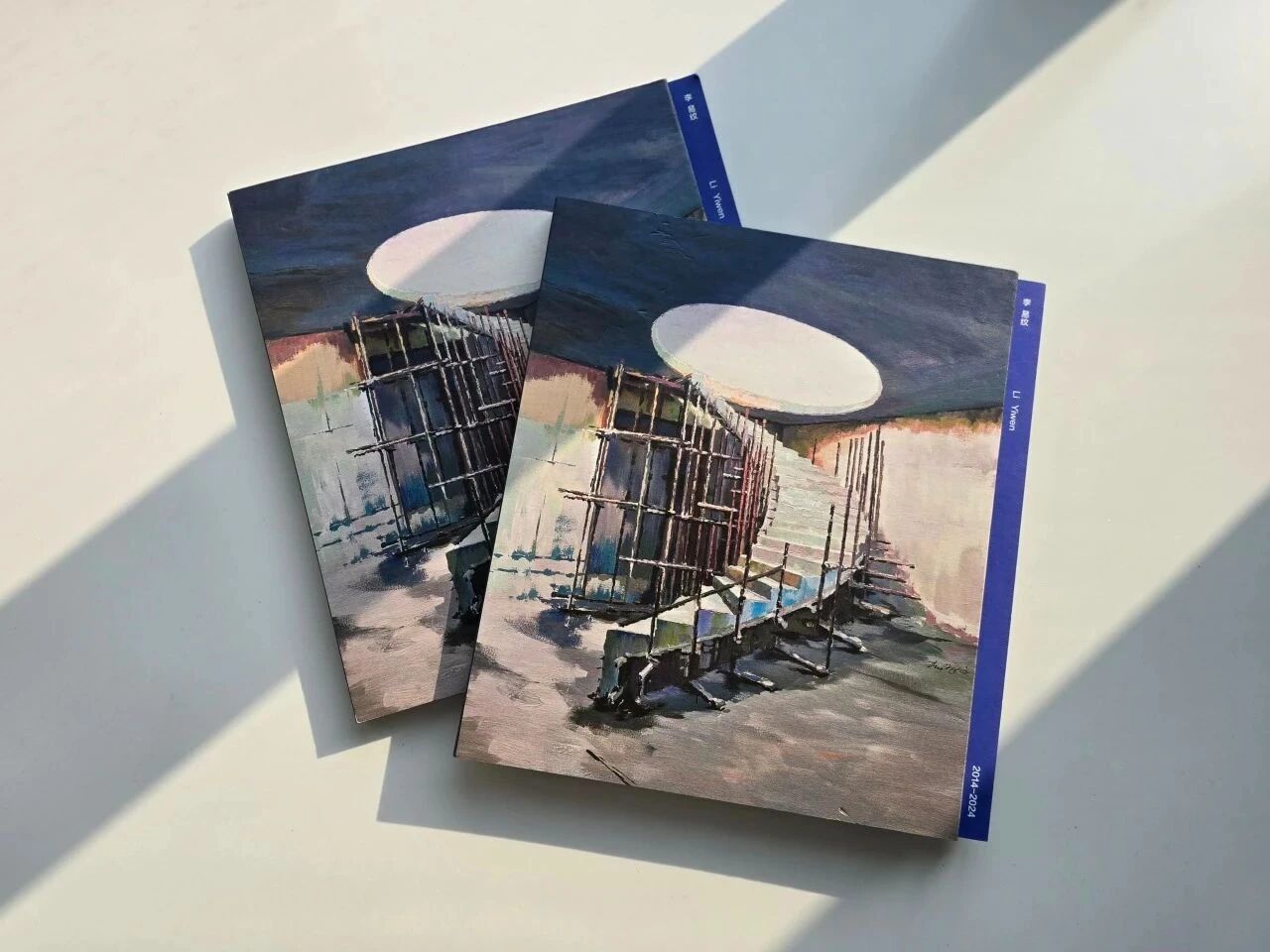
- Mocube Publications | Li Yiwen: Flowing Time, Expanding Scenery
- 2025-09-06
Mocube and Leo Gallery is pleased to introduce the catalogue of Li Yiwen, which meticulously compiles Li Yiwen's artworks created over the past decade, exhibition-related texts by art historian / curator Ruth Noack and Wang Che, as well as installation views capturing the artist's exhibition highlights. Each work is presented with exceptional attention to detail, inviting readers to immerse themselves in Li Yiwen's distinctive artistic vision. Additionally, the photographs from the exhibitions showcase their ingenious display arrangements once again, offering a profound artistic experience to those unable to attend in person.
Edit by Wang Che & Li Yiwen
Text by Ruth Noack & Wang Che
Translation by Shana Wu & Zang Yusi
Proofreading by Charlize Li & Yin Nuo
Book Design by Pigao
Published by Mocube & Leo Gallery
Time is, in Li Yiwen’s paintings, watercolours and models, always multi-directional. It stands still, because the objects he paints are planted into illusionary scenarios, and this displacement creates an unsettling absence of reality. It extends into the past, because his objects are generally either man-made (they have a material history) or they came into existence long before man-kind. Time projects into the future, because the objects might suggest a future use. Time is also compressed in the paintings in a materialist sense, because the artist took time to paint them. Finally, for the viewer, time might expand. This is the case not only in the act of viewing, but because, when confronted with these melancholic timescapes, we might start asking ourselves: “What have we done with this world?”
Nevertheless, abandonded building sites settled in nature can provoke, if not revery, at least benevolent contemplation in their viewers. There is something endearing about the efforts of human beings, even if they are failed. And because they failed their intended purpose and fell out of time – into stillness - they provide us viewers with a respite from our own diachronicity, our own flow of time. They create the distance we need in order to look at ourselves. Because this is, in most cases, not a very deep look, more a whiff or trace of understanding how we (or how our bodies) relate to time, this results in a warm and fuzzy feeling, or possibly a sadness – “Look at this never built, broken down, attempt at a building… what a waste!” – but not a deep sadness.
Li Yiwen’s paintings carry these associations in their DNA, that is to say, they rely on emotions that we remain unaware of, because they are not in the foreground – they are not the artist’s primary goal. He is not giving us a quaint, picturesque view of a ruin in the distance, no: the building has been propelled right into our field of vision in such a way that it almost, but not quite overwhelms our senses with its monumentality. Almost, but not quite: The viewer is fully enveloped into the building site, but not cowered by its size. Maybe that is, because its monumentality is unashamedly artificial? Take the eccentric way that stories are stacked on top of each other to create a swirling, over the top feeling or take the fish-eye perspective, these are tropes that are used to create an effect of viewer-immersion similar to what we might encounter in an ego-shooter game.
Icebergs do not need the viewer’s ability to focus on them in order to be beautiful. They simply are majestic. Maybe they are majestic, because they have been around for eternity? Because they have simply been in existence for so long? Are they of the past or the future? Who cares about humanity, as long as there are icebergs? Li Yiwen took a trip up north with a few friends and fell in love with icebergs. Now he is painting the afterimage of that love. In his versions, icebergs are highly stylized. They are also more colourful than life. Not even a filter on the artist’s Huawei phone would be able to produce such sparkle. Incidentally, Li Yiwei’s phone was the only picture-taking apparatus carried on the journey that did not freeze up in the cold, thus giving evidence to the fact that the heroic and the banal remain close friends.
--Ruth Noack
-

- Mocube News | Dai Chenlian Exhibition Site and Information in May
- 2023-06-04
Living a Performance Artist's Life ——2023 Performance Art Documental Exhibition
Opening Performance "Applause I"
Show Time:2023.5.13, 4:00 to 4:30 PM
Artist:Dai Chenlian
Exhibition Location:Madein Art Museum
"Applause I" is the "Actor" series of Dai Chenlian's theater project. The work focuses on the causes of Lu Junfei, an actor he once worked with, who studied communication engineering under the background of the reform and opening-up policy and then entered a foreign-funded enterprise, with a simple and moving narration, interspersed with narration and professional foreign trade management movements. Lu Junfei taught Dai Chenlian the basic postures of ballet, daily habitual movements and professional etiquette movements of foreign trade, which is not only the friendship of mutual learning after their reunion, but also the spiritual connection after the mutual dissolution of their physical movements. In the space of the MadeIn Gallery, where the relationship between abandonment and reconstruction is mixed, Dai Chenlian presents Lu Junfei with this performance, showing her confusion and happiness, past and present, reproducing Lu Junfei's tracing and examination of the history of engaging in foreign trade affairs, (the history of foreign investment in China, where foreigners provided equipment, raw materials, incoming samples and were responsible for exporting the products, and Chinese enterprises provided land, plants and labor) The "three comers, one complement" economic and trade cooperation model was very common after the reform and opening up), is a personal history belonging to her and a common memory of a generation.
-

- Mocube News | Dai Chenlian Exhibition Site and Information in May
- 2023-06-13
"Applause II"
Performer: Dai Chenlian
Date: 2023.5.21, 7:00-8:30 PM
Address: The Cloister Project, 2F, The Cloisters Apartments, No.62 West Fuxing Road, Shanghai
The work "Applause II" originates from the period when I was stranded in my hometown (Shaoxing) to recuperate from the collective infection of New Crown Pneumonia in China, and I used to go for walks along the river. I mixed the sounds of the river at that time with the sounds of Shanghai's history, using the sounds and sound fields as an index to link time and space and a clue to edit history. The personal narrative unfolds as a repeated reminder of the immediate, while the compound crossover of sound and image forms a continuous spatio-temporal overlay, bringing us into multiple strange and magical spatial tunnels where time, events and people meet and disperse at numerous warp and weft points, allowing us to wander through the fragments of memory and reality. These fragments are actually portraits of communities, paying tribute to those who are still alive and those who have passed away, and connecting the meaning of memory and love in the post-epidemic era.
Text by Dai Chenlian
-

- Mocube News | Dai Chenlian Exhibition Site and Information in May
- 2023-06-13
More Than Human
Participating Artists: Andrew Thomas Huang /Anna Raimondo /Artor Jesus Inkerö /Anna-Sophie Berger /Black Birds Creative Co. /Dai Chenlian /Die Ge / ErGao /François Chaignaud /Hu Wei /Jes Fan /Jake Elwes /Konstantin Zhukov /Lilibeth Cuenca Rasmussen / Martina Menegon /Melanie Bonajo /Miriam Cahn / Otay:onii /Prinz Gholam /Tao Hui /Zheng Bo
Exhibition dates: 27 May 2023 – 23 July 2023
Opening days: Tuesday to Sunday
Time: 10:00 am to 6:00 pm
Venue: Blanc Art Space A1
Human being
NOUN
1. any individual of the genus Homo, especially a member of the species Homo sapiens.
2. a person, especially as distinguished from other animals or as representing the human species.[1]
It is clear from this definition that humans perceive themselves to be superior to — and separate from — other beings. This concept of the human is built on the idea of a liberal form of freedom: the ablitity to instil their desires and needs onto other entities and the world itself. [2] Humans also seemingly believe that they are free of any responsibilities for the problems facing our world today, the most urgent of which include the exploitation of other species, eradication of culturessocial isolation and gender discrimination. Specifically, they believe themselves free from the need to make any substantial changes to their lives as they can solve these problems with technological solutions.
In More Than Human, we challenge the very idea of “humans” itself. We begin by asking who actually is a human. But in trying to figure out the “who,” we cannot neglect the “how” — the process of becoming (non-)human. How, for instance, do humans order the world? And how are the problems facing the world the result of the humanist norms and structures that order our world today? Most importantly, we look at how a post-anthropocentric world would look like — one where human beings do not reign supreme and acknowledge their interdependency and entanglements with other species.
-

- Mocube News | Kang Jing Exhibition Site and Information in May
- 2023-06-13
CLOUDSCULPTURE—— THE FIRST INVITATIONAL EXHIBITION
Ready-made Life Realistic Technology
Artist: Kang Jing、Liu Fujie、Li Nu、Liu Yazhou、Liu Zhan、Qin Ga、Tan Yingjie、Zhang Yi
Curator: Feng Xi
Exhibition Time: 2023.5.1-8.27
Address: Song Art Museum
For the past three years, life has entered the gyroscope of destiny at a uniform speed. The whip that controls the rhythm always jerks in the same direction and strength at the moment it is about to stop, triggering the gyroscope body to rotate into another set rate, involuntarily transforming you and me into one. Life becomes a designated ready-made product, reality becomes a technical method of manipulation, and under the set algorithm, reality pushes life beyond common sense and experience. In life, the logic and method of using everyday objects are controlled by the user, and the person becomes the master of the object, while the desire for the object also controls the psychology of unlimited possession. The artist connects the readymade life and the readymade products in life to the destiny of individuals and becomes the raw material for transformation. The exhibition is divided into five chapters: Chapter 1 "Besieging Fate", Chapter 2 "Useful Objects Useless Life", Chapter 3 "Look at the World and You at the Window", Chapter 4 "Body Machine", and Chapter 5 "Only Labor Not Production". The five chapters jump between ready-made and realistic, between life and technology, describing the powerlessness that reality has given to each person for three years.
-

- Mocube News | Zheng Jiang Exhibition Site and Information in May
- 2023-06-13
Gallery Weekend Beijing 2023 Up&Coming Sector
Artists: Chen Qiulin、Chen Ruofan、Fan Xi、Fei Yining、Gui Kuan、Huang Ziyue、Liu Guangli、Liu Yujia、Qi Yao、Wang Yuchen、Yu Guo、Zheng Jiang
Guest Curator: Pu Yingwei
Date: 2023.5.28-6.4
Address: 2nd Floor, 798 Art Center
Gallery Week Beijing 2023 New Power Unit "Youth Today! with artist Pu Yingwei as the guest curator, aims to present a global vision with local roots, a local youth culture in the midst of the world's evolutionary waves.We experience a sense of unrestricted and unrestrained youth culture from the representations of different generations. The diverse forms of expression by today's artists in informal settings call us to pick up the responsibility of "youth" and enter the contemporary scene to recreate the unquenchable flame in our hearts.In this "Youth Today!" will focus on video, performance art, and performance art, with works that bring ideas and perspectives into the flow of practical video and physical dynamics.A total of 12 artists will be invited to participate in the video section of the exhibition with their works. At the same time, the "Youth Today! also includes a selection of documents from early contemporary art in the new China, looking at the view of youth from different eras through history and reflecting on the present we live in.
-

- Mocube × GWBJ | Li Yiwen: Gaze Beyond Time
- 2023-06-04
Li Yiwen's art practice mainly employs painting as the medium. His painting entails the thinking and interest in time and space. The experience in memory and the experience at present penetrate each other and accumulate to become the source of inspiration for expression. Li Yiwen often uses post-modern methods to filter, select, and enhance images to integrate illogical, fictitious, ectopic, and intuitive elements into the paintings. While subverting the previous painting narratives, they generate new pictorial meaning.
-

- Mocube Publication | ZHENG JIANG: GROTTOES TRILOGY
- 2023-06-04
- The bilingual catalogue "GROTTOES TRILOGY" is now available, bringing together nearly 70 works from Zheng Jiang's "Feitsui", "Earth Pearls" and "Burning Pagoda" Grottoes Trilogy. It also includes the curator and writer Yao Siqing's "Measuring the Journey Home: A Reading Zheng Jiang's Grottoes Trilogy", which focuses on the connection between Zheng Jiang's past and present works; "Zheng Jiang's Seven Key Words", written by curator Wang Che's detailed introduction to Zheng Jiang's work and interpretation of his works in recent years; and the artist's The artist's own reminiscent textual work "Good Creek" is also included.The book is designed by the artist Yan Zhou. The book is wrapped in a delicate black cotton cloth and produced with an exquisite embossing process. The cover of the book is hand-painted by the artist, and is presented in the form of a painting of red (Fei) and green (Cui) tuff; photographic images of the cave wilderness are used as a backdrop, guiding the reader to read the book as if entering the scene of the cave where the artist created it, and then to think about and look back at the place where they live.The main body of the catalogue is arranged chronologically, with "Feitsui" in 2019, "Earth Pearls" in 2021, and "Burning Pagoda" in 2023. The three exhibitions are chapters that reproduce Zheng Jiang's artistic practice in various forms, such as video, painting, live sculpture, and documentary photography, and also present the artist's local creation sites and works and documents from three exhibitions in his hometown since 2017, highlighting his diverse artistic expressions over the past seven years.
-

- Event: New Book Launch and Discussion | ZHENG JIANG: GROTTOES TRILOGY
- 2023-06-04
A depression named Shixia, the birthplace of artist Zheng Jiang, is located in Jinyun County, Lishui City, Zhejiang Province. Zheng Jiang grew up in an environment where his father's family was mostly engaged in quarrying.
From 2017, Zheng Jiang returned to the mountain pass under the stone from Beijing, and started his seven-year-long local creation activities, and launched "Feitsui", "Earth Pearls", and "Burning Pagoda" in 2019, 2021, and 2023 at Mocube in Beijing, He has produced a variety of live sculptures, videos and paintings over the years. Here, Zheng Jiang has nurtured and created his miracles with his own strength, making the vast grottoes glow with red and green "light", chiseling the rolling stones of the mountain pass into "teardrops" scattered on the earth with his bare hands, and deeply engraving the capital "Love" on a huge wall of rocks. "Love".
In May 2023, a publication containing the works and documents of Zheng Jiang's three exhibitions "Feitsui", "Earth Pearls" and "Burning Pagoda" was published under the title "Grottoes Trilogy". The abandoned site left after artificial quarrying.
-

- Mocube Live | 12 Artists' Works at Beijing Contemporary Art Expo - Booth C15
- 2023-06-04
北京当代·艺术博览会-重聚 | 墨方展位号C15
Beijing Contemporary Art Expo REUNION | Mocube Booth C15
参展艺术家 | Artists
蔡龙飞 Cai Longfei | 曹应斌 Cao Yingbin | 戴陈连 Dai Chenlian | 付经岩 Fu Jingyan | 贺天琪 He Tianqi | 康靖 Kang Jing | 来金娜 Lai Jinna | 栾雪雁 Luan Xueyan | 李易纹 Li Yiwen | 严岩 Yan Yan | 张震宇 Zhang Zhenyu | 郑江 Zheng Jiang
贵宾预览 | VIP Preview
2023.04.28(周五 | Fri.)12:00-19:00
2023.04.29(周六 | Sat.)11:00-18:00
公众开放日 | Public Days
2023.04.30(周日 | Sun.)11:00-18:00
2023.05.01(周一 | Mon.)11:00-18:00
地点 | Location
全国农业展览馆11号馆 | Hall 11 of National Agricultural Exhibition Center
-

- Mocube | Beijing Contemporary Art Expo REUNION
- 2023-06-04
北京当代·艺术博览会-重聚 | 墨方展位号C15
Beijing Contemporary Art Expo REUNION | Mocube Booth C15
参展艺术家 | Artists
蔡龙飞 Cai Longfei | 曹应斌 Cao Yingbin | 戴陈连 Dai Chenlian | 付经岩 Fu Jingyan | 贺天琪 He Tianqi | 康靖 Kang Jing | 来金娜 Lai Jinna | 栾雪雁 Luan Xueyan | 李易纹 Li Yiwen | 严岩 Yan Yan | 张震宇 Zhang Zhenyu | 郑江 Zheng Jiang
贵宾预览 | VIP Preview
2023.04.28(周五 | Fri.)12:00-19:00
2023.04.29(周六 | Sat.)11:00-18:00
公众开放日 | Public Days
2023.04.30(周日 | Sun.)11:00-18:00
2023.05.01(周一 | Mon.)11:00-18:00
地点 | Location
全国农业展览馆11号馆 | Hall 11 of National Agricultural Exhibition Center
墨方将于4月28日至5月1日参展北京当代·艺术博览会-重聚,展位号C15,期待您的莅临。
-

- Cao Yingbin "Journey to the West" in the "The Message is Medium" at the AMNUA
- 2023-06-04
Journey to the West, Cao Yingbin
"Shattered Mirrors Cannot be Reassembled, Fallen Flowers Cannot be Returned to the Branches"_The Message is Medium Episode 2
-

- The Opposite House x Mocube|Kang Jing"Angular on My Bone" opens in TaiKoo Li Sanlitun on August 24
- 2023-06-04
It is an ongoing question how nature retains coherence in a modern, urban environment. Today, even a tree branch or a wooden stick seems to be incompatible with the orderly and modernized city. Humans endure the same predicament.
Throughout the ages, Chinese people have paid attention to the relationship between nature and people, and between nature and architecture. Ancient Chinese corresponded human facial structure with mountains and rivers, such as the left cheek corresponds to Mount Tai, the upper forehead corresponds to Mount Heng. This methodology, which closely connects human beings with natural beings and mirrors each other for cognition can reflect small things from a broad sense of space, and vice versa from a micro perspective to reflect the vast.
The shape of a tree or a brunch is a thread that the exhibition revolves around. These works shape the sense of life. Kang proceeds from the exterior to the interior, dissects the flesh and exposes the bones of the objects. The sculpting of the work begins with observation, extends to touch and awareness that comes superficially and assimilates to deeply ingrained, at last even a sickening feeling is developed. The natural structure signifies the morphological relationship of mutual surpassing and mutual avoidance formed by branches fighting for living space in development.
The angular form not only indicates the physical characteristic of the trees but also refers to my sense of life integrated with nature.
-

- Mocube | Chu Bingchao participates in GWBJ 2022 Main Sector Special Exhibition "Crosstalk"
- 2023-06-04
Crosstalk
Exhibition Time:2022.6.24-7.3
Address: 1F, Hall A&B, 798 Art Center, Beijing 798 Art Zone
The Recitativo in the exhibition's title, "Crosstalk," is a reference to the name of a recitative-like tune in opera, a form of singing that mimics the rhythmic and tonal changes of speech and is used to move the plot forward, serving as an "introduction. It serves as an introduction. Through revisiting and re-reading the artist's works, the curatorial team observes the existence of the creator's experience in time and space and in the text through the chapters "Leaning Down" and "Wandering into the Darkness" respectively. The two seemingly independent leads frequently echo and intersect in the flowing narrative, opening a dialogue with each other in an overlapping manner. Among them, "Bend Over" includes more than ten artists who live and work in Beijing, attempting to focus on individual practices of daily life as a form of resistance, while marking these artists as both shapers of Beijing and witnesses of the city's changing times.
-

- GWBJ Conversations: The Skeleton of Sculpture and Nature
- 2023-06-04
Conversations: The Skeleton of Sculpture and Nature
Guest Speaker: Dai Zhuoqun, Feng Xi, Wang Che
Artist: Kang Jing
2022.6.26, Sun/16:00 – 17:00 PM
In addition to being an important part of the structure of a living body, "bone" has many derivative and symbolic meanings, and many important concepts in ancient literature and painting theory are related to bone. In the Wei and Jin dynasties, the term "bones" was often used in the evaluation of characters. Gu Kaizhi introduced the term "bone method" to the rhetorical field of painting, referring mostly to the temperament revealed by the bones of the figures painted. Xie He's use of the term "bone method" has shifted to the beauty of the bones of the brush, which is more abstract.
The rules followed by the statues of the past generations are also a summary of practical experience under the influence of this philosophy.
The word "bone" comes from traditional Chinese phrenology, which corresponds the structure of human face to natural mountains and rivers, such as the left cheek corresponds to Dongyue and the upper forehead corresponds to Nangyue. This methodology of closely associating human beings with all natural things and cognizing them in reflection of each other can be used to view tiny things from a natural and extensive sense of space, or vice versa, to achieve a vast extent by exhausting the subtle.
From this perspective, on June 26th, 2022, at 4pm, as part of the Gallery Week academic program, Dai Zhuoqun, Feng Ruoxi, Kang Jing, and Wang Che will have a conversation on the topic of "Sculpture's Bone Method and Nature's Bone Phase" at Mo Fang Space. The conversation will be based on works from Kang Jing's solo exhibition "Carving Bones", which opens at MoFang Space on June 11, 2022. Details will be posted on the public website "Cloud Sculpture".
The works in this exhibition are shaped by the sense of life of objects. When the author makes them, he dissects the flesh and reveals the bones from the surface to the inside. These shapes begin with observation, observation to touch, to perception, to skin, to carving bone and flesh. The bones here are the natural and natural structures, the clues that appear and disappear, the axes of transformation of yin and yang."
-

- Mocube at Art SHENZHEN 2021 | Booth B26
- 2023-06-14
艺术深圳2021 | 墨方展位号B26
Art Shenzhen 2021 | Mocube Booth B26
参展艺术家 | Artists
陈川 CHEN Chuan | 曹应斌 Cao Yingbin | 贺天琪 He Tianqi | 韩五洲 Han Wuzhou | 李易纹 Li Yiwen | 刘瑜 Liu Yu | 姜波 Jiang Bo | 康靖 Kang Jing | 王锐 Wang Rui | 郑江 Zheng Jiang
藏家预览 | Collector Preview
2021/9/9 周四, 14:30 - 21:00
公众开放 | Public Days
2021/9/10-9/11 周五、周六, 10:00 - 19:00
2021/9/12 周日, 10:00 - 17:00
地点 | Location
深圳, 会展中心6号馆 | Hall 6, Shenzhen Convention & Exhibition Center, Shenzhen
-

- Mocube Publication |“Mocube Five Years”
- 2023-06-14
- This publication is a complete collection of the work of 92 artists and curators in 48 exhibitions held over a five-year period since the launch of the space's exhibition program in July 2015 until July 2020. We hope that this book will serve as a summary of everyone's phased work, reflecting Mocube's relentless persistence as a unique independent art space that encourages and promotes the creative activities of young contemporary artists and provides them with a continuous platform for excellent presentation.